India's is defending the world chess championship against fast-rising Uzbek grandmaster in the youngest title match in the competition's 140-year history. The best-of-14-games contest is scheduled to take place from 24 November to 12 December at the Fondation Martin Bodmer outside Geneva, with an overall prize fund of $2.5m (£1.9m).
Gukesh has developed his dark-squared bishop and Sindarov has centralized his queenside knight (12 ... Be7 13 Ne4). The pace of play has slowed considerably as the players begin to grapple with the strategic subtleties of the Berlin.
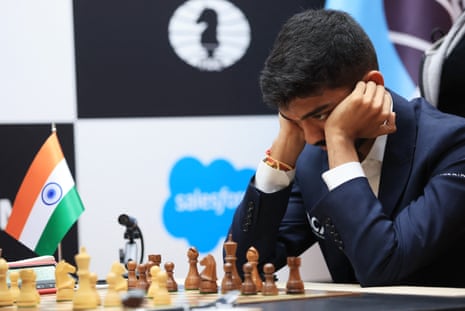
An email from the always welcome Gary Naylor, who sees parallels between the world chess championship and another of Europe's great endurance events:
Given the location, the schedule, the fact that each leader has a team supporting him and, more than anything, the stamina required, this feels like the Tour de France. I suppose players have the ability to make stages – games – hard or easy by their strategies too.
Any sign of lycra?
No lycra to report, Gary, but there's certainly something to the analogy. The ability to conserve energy over a three-week campaign, knowing when to attack and when to settle for a quiet day, is an underrated component of world championship matchplay.
Gukesh has been mulling his response to 12 Be3 for more than 10 minutes, after spending about eight minutes on his previous move.
"He still knows the position, but he is taking time to make sure he makes the right moves," Russian grandmaster Peter Svidler says on Fide's broadcast. "But Gukesh is already down almost 18 minutes on the clock. Considering he's playing one of the most topical openings of the past 25 years, that's some time expenditure."
Gukesh has brought his knight to g6, putting pressure on the advanced white pawn on e5, and Sindarov has continued his development by bringing his bishop into play (11 ... Ng6 12 Be3).
Gukesh has returned his king to its original square and rerouted his knight (9 Rd1+ Ke8 10 Nc3 Ne7 11 h3). Sindarov's last move prevents black's light-squared bishop from coming to g4 and pinning the knight on f3, while giving his own king some breathing room.
"I think it's important to highlight for our viewers that black is not playing for a draw," the Hungarian grandmaster Judit Polgár says on Chess.com's broadcast. "Black is just deciding to go into an endgame or a middlegame without queens, where it seems like only white has a slight edge. Black has doubled pawns on c6 and c7, black has the bishop pair, but basically black can go b6, develop the pieces properly."
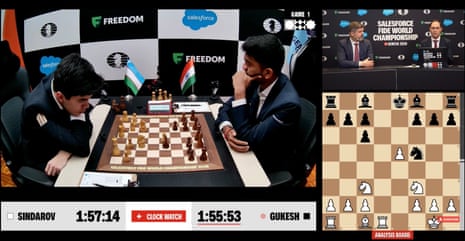
We're heading straight into the famous Berlin endgame (4 O-O Nxe4 5 d4 Nd6 6 Bxc6 dxc6 7 dxe5 Nf5 8 Qxd8+ Kxd8). The queens are off the board after only eight moves, leaving white with a kingside pawn majority and black with the bishop pair but doubled c-pawns and a king that has forfeited the right to castle.
Don't mistake the early exchange of queens for a lack of ambition. The resulting position is deceptively rich in strategic possibilities and has been the subject of decades of analysis at the highest level. Gukesh has continued with 9 Rd1+, and both players are still moving quickly.
The players have shaken hands and we're off! We have a Berlin defense of the Ruy Lopez (1 e4 e5 2 Nf3 Nc6 3 Bb5 Nf6), one of the most thoroughly analyzed openings in modern chess.
The Berlin famously helped Vladimir Kramnik dethrone Garry Kasparov in their 2000 world title match in London and has been a staple of elite chess ever since, earning a reputation as one of black's most reliable weapons against 1 e4.
We're eight minutes to the scheduled first move, but American grandmaster Maurice Ashley has started with his introduction of the players to the playing hall. Gukesh enters first and takes his seat behind the black pieces. Sindarov, playing as white after Sunday's drawing of lots, enters second.
If you're looking for some pre-match reading, the Guardian spoke exclusively with Javokhir Sindarov on Sunday about his meteoric rise, his love of Lionel Messi, his plans to play GTA VI once the match is over and why chess's happy warrior believes there's more to life than the game. A taste:
"I'm the guy who can't play games just for fun," Sindarov tells the Guardian less than 48 hours before Tuesday's world championship opener in Geneva, smiling at the absurdity of it. "If I play something, I always try to learn, trying to become better."
That means poring over Counter-Strike tactics and watching YouTube tutorials before joining in with his mates. There is, it appears, no such thing as a casual game in Sindarov's world, much less a friendly. "I always like to beat my friends," he says. "I watch some video lessons and then come and beat them after some tournaments. I think the best thing is to beat your friends in some game."
It is a revealing admission from a young man who has acquired a reputation for being uncommonly relaxed at the chess board. While many of the world's elite players seem to carry the weight of every position on their shoulders – the viral clip of Sergey Karjakin agonizing for 25 minutes over a move during the 2016 world title match remains a cult classic in chess circles – Sindarov frequently gives off the impression of someone who is simply enjoying himself. The easygoing mien of the sport's happy warrior is a quality that has caught his opponent's attention. "One thing I learned from Sindarov is that he seems to be so happy while playing chess," Gukesh Dommaraju, the reigning world champion, said in an interview published last week.
We've gone through the 140-year history of the world championship and chosen 22 of the most memorable games. You can go move by move through each of them here. It's the perfect timesuck in the final run-up to today's first move.
From the middle of the 16th century, there have come down to us the names of chess players who have been widely regarded as the strongest of their time. The earliest of these was the Spanish priest Ruy López de Segura, after whom one of the most popular openings of modern times is named. Others who followed include the Calabrese Gioachino Greco, François-André Danican Philidor, Louis-Charles Mahé de La Bourdonnais, Alexander McDonnell, Howard Staunton, Adolf Anderssen, Mikhail Chigorin and Paul Morphy, each of whom are lionized for their contributions to the development of theory and strategy as well as their dominance over their board during their respective eras.
But not until Wilhelm Steinitz and Johannes Zukertort sat down in a small room at 80 Fifth Avenue in New York City on the afternoon of 11 January 1886 did a formal competition to determine the best player on the planet come to pass. Their first-to-10-wins encounter was held in three US cities over the next 78 days for a prize fund of $4,000. Since then, the world chess championship has provided the stage for countless unforgettable contests showcasing the precision, imagination and brilliance of the royal game at the highest level.
The legitimacy of the world championship, of course, remains a subject of lively debate. The absence of Magnus Carlsen continues to cast a long shadow over the sport's showcase event. The 35-year-old Norwegian has held the world No 1 ranking for more than 15 consecutive years and was widely regarded as the game's strongest player even before he defeated Vishy Anand for the world title in 2013. He only strengthened his claim as the greatest player of any era in 2021, when he crushed Ian Nepomniachtchi in Dubai in his fourth successful defense of the crown.
But Carlsen declined to defend his title for a fifth time in 2023, citing a lack of motivation to endure the months-long grind of preparation that championship matches demand. Only twice before had the chain of succession that stretches back to Wilhelm Steinitz in 1886 been broken: when Alexander Alekhine died as champion in 1946 and when Bobby Fischer forfeited the title in 1975.
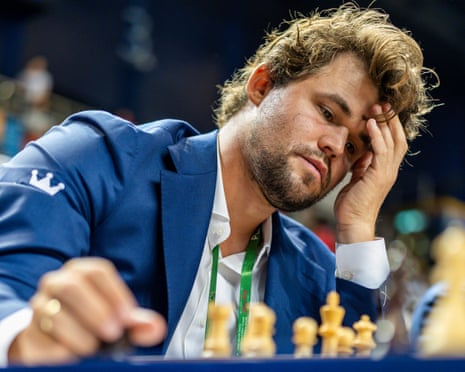
Ding Liren went on to defeat Nepomniachtchi for the vacant title before losing it to Gukesh Dommaraju in Singapore the following year. Now Gukesh faces Sindarov in a match between two 20-year-olds ranked No 26 and No 4 in the world respectively, while the planet's top-ranked player remains on the sidelines – at a time when his No 1 ranking is looking more vulnerable than any time in anyone's memory. The generational stakes are undeniable, but the question that has dogged the championship since Carlsen walked away remains unresolved: can the winner truly claim to be the best chess player in the world?
For two elite players born in the same general part of the world barely six months apart, their competitive history is remarkably sparse: just three encounters in classical chess. Sindarov holds a 2½-½ advantage with two wins and one draw in their lifetime head-to-head, which dates back to their first encounter as tweens at the Moscow Open in 2018. Their most recent meeting happened in January at the prestigious Tata Steel tournament in Wijk aan Zee, where a tense positional struggle gave way to a wild, time-scrambled endgame before the pair settled for a draw after 78 moves. Sindarov also holds a 2-1 edge in their three rapid and blitz contests this year.
Gukesh's form has largely gone off the rails since reaching the summit 23 months ago in Singapore. After making it to No 3 in the world with a peak rating of 2794, the Indian suffered a prolonged run of disappointing results, including a joint-last finish at March's Prague Chess Festival and last-place showings at Norway Chess and the Chennai Grand Masters. He subsequently withdrew from the classical portion of the Grand Chess Tour and had tumbled to No 32 in the rankings by September, when his live rating briefly dipped below the 2700 barrier for the first time in four years, although his performances improved at that month's Chess Olympiad.
Many of the world's top grandmasters have expressed deep pessimism about Gukesh's chances in Geneva due to his lengthy slump and Sindarov's sustained upward tick. So too have the bookmakers, who have installed the Uzbek as a clear frontrunner at roughly 1-3 odds despite Gukesh being the champion. Carlsen has described Sindarov as "a pretty significant favorite", citing the Indian's tendency to take excessive risks. "His evaluations are way too optimistic," the world No 1 said recently. "That makes him take way more chances than he should. I think especially now his confidence hasn't been too high, he just tries to do a little bit too much."
Yet one factor in Gukesh's favor is his firsthand experience in the cauldron of a world championship match, where the intense psychological and physical rigors of facing the same opponent for weeks on end can be as punishing as the chess itself. Caruana, the world No 3 and former world title challenger who pushed Carlsen to the brink in 2018, has cautioned against writing off the champion despite his struggles. "The kind of ability he had – or has, whatever you want to say – it doesn't disappear overnight," Caruana said in September. "So, in my opinion, it can reverse at any moment."

Here's a review of the format for the world championship match. Gukesh and Sindarov will play up to 14 classical games with each player awarded one point for a win and a half-point for a draw. Whoever reaches seven and a half points first will be declared the champion (and no dead rubbers will be played).
The time control for each game is 120 minutes per side for the first 40 moves, then 30 minutes for the remainder of the game, with a 30-second increment per move starting with move 41. That means games can stretch beyond seven hours, testing both players' concentration and endurance. Players are not permitted to agree to a draw before black's 40th move, a rule designed to discourage short, uneventful games. A draw claim before then is only allowed in the case of threefold repetition or stalemate, subject to approval by the chief arbiter or deputy arbiter.
If the score is level after 14 games, a series of tiebreaks will be played on 12 December, starting with four rapid games at 15 minutes per player plus 10 seconds per move. If still tied, the players will contest two games at 10 minutes plus five seconds, followed if necessary by two blitz games at three minutes plus two seconds. Further single blitz games will be played until a winner emerges. Three of the past five world championship matches have been deadlocked after the classical portion and required tiebreaks: 2016, 2018 and 2023.
The complete official regulations can be found here.

Hello and welcome to Geneva for day one of the World Chess Championship. Over the next three weeks, India's defending champion Gukesh Dommaraju and Javokhir Sindarov of Uzbekistan will compete in a scheduled best-of-14-games match for the sport's most prestigious title and a share of a $2.5m prize fund. The setting is the Fondation Martin Bodmer in Cologny, an affluent suburb overlooking Lake Geneva, where the two 20-year-olds will make history as the youngest pairing ever to contest a world championship match in the competition's 140-year history.
Gukesh became the youngest undisputed world chess champion in history when he defeated China's Ding Liren in Singapore in December 2024, aged just 18, shattering the record held by Garry Kasparov, who was 22 when he dethroned Anatoly Karpov in 1985. An aggressive player known for creating sharp, tactically complex positions aimed at unsettling opponents, the Chennai-born grandmaster has struggled badly for form since winning the crown, sliding from a career-high No 3 to No 26 in the world rankings and raising questions over his chances of retaining the title in his first defense.
Sindarov, meanwhile, has emerged as one of the most formidable talents of a new generation of Uzbek grandmasters. Born in Tashkent, he became a grandmaster at 12 years and 10 months, the second-youngest in history at the time, and secured his place in Geneva by winning the eight-man Candidates tournament earlier this year. A fearless, resourceful player in a rich vein of form, he enters his first world championship match ranked fourth in the world, up from No 25 last year and a remarkable 22 places above the reigning champion, and with a favorable head-to-head record against Gukesh in classical chess.
We're roughly 80 minutes away from the ceremonial opening moves. Fide president Timur Turlov will do the honors for white, with five-time world champion and Fide deputy president Viswanathan Anand moving for black. Plenty more to come between now and then.
India's is defending the world chess championship against fast-rising Uzbek grandmaster in the youngest title match in the competition's 140-year history. The best-of-14-games contest is scheduled to take place from 24 November to 12 December at the Fondation Martin Bodmer outside Geneva, with an overall prize fund of $2.5m (£1.9m).
Bryan will be here shortly. In the meantime here's our watch guide for this year's World Chess Championship,