popular Christmas tradition in Japan is to head to KFC but there is an unexpected item on the menu to chew over this year for the millions who do so – a meaty debate over Hajime Moriyasu's eight years as national-team head coach. Among the many consequences of the Asian Cup's postponement from January 2027 to December is the fact his tenure has ended early.
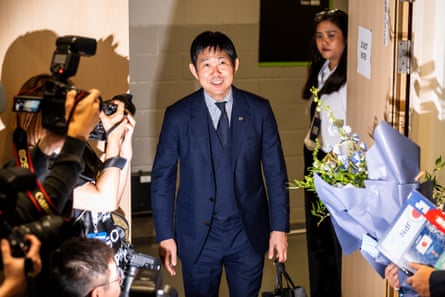
The 58-year-old was supposed to stay on until February to cap that lengthy spell with (hopefully) a deserved trophy, hand over to Go Oiwa and then, perhaps, blaze a trail to Europe. Instead he left this month, after 113 games in charge during which Japan became a global force to be reckoned with, even if there are those who think he underdelivered.
It is easy to forget that in the eight years before his 2018 appointment, there were six different coaches on the national team bench. Javier Aguirre lasted just 10 games before leaving in 2015 after being named in a Spanish anti-corruption investigation. Then came Vahid Halilhodzic, stock high after leading Algeria to the knockout stages of the 2014 World Cup, but the Bosnian's more pragmatic and direct style never seemed suited to that of his employers. Shinji Kagawa was dropped, Keisuke Honda benched and the rest seemed shocked.
A 4-1 loss against South Korea in December 2017 led to an emergency Japan FA meeting and then, in April, Halilhodzic was fired, just weeks away from the World Cup – not quite the scene of serenity and stability that many associate with the Samurai Blue, especially as he threatened to sue the JFA chief executive, Kozo Tashima, now challenging Gianni Infantino to be Fifa president, claiming an illegal dismissal. Under Akira Nishino at the 2018 World Cup, Japan squeezed into the knockout stages by receiving fewer yellow cards than Senegal.
Things have been much more settled since. Under Moriyasu Japan have become, by some distance, the best team in Asia. Fans do not have to look far for a glimpse of how things can go wrong. South Korea have talented players and went to the World Cup with Son Heung-min, a Paris Saint-Germain midfielder in Lee Kang-in and Bayern Munich's centre-back Kim Min-jae, but they were awful and have been in meltdown ever since. Iran fans are desperate to see the back of their coach, Amir Ghalenoei; Saudi Arabia fired theirs just before a World Cup that went badly; and Qatar, back-to-back continental champions, are about to say goodbye to Julen Lopetegui after an underwhelming period.
It wasn't just about rivals going backward, though. Clear progress has been made, standards have risen and so has confidence. After Japan became the first team to qualify for the last World Cup in March 2025, the captain, Wataru Endo, told fans it was no longer enough to be content with a place in the tournament but to look to win it. That may have been a tad optimistic and Moriyasu later talked of the last eight.
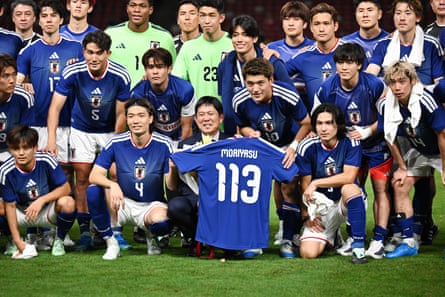
Japan eased through their group to set up a last-32 clash with Brazil. In the first half in Houston, the South Americans were very much second best. However, the Asian team sat back after the break and ended up losing in stoppage time. What made it worse was that it was a fifth failure to get past the first knockout game. Back in 2022, perhaps too much respect was paid to Croatia and the result was a penalty shootout defeat. It reinforced the claims that Moriyasu was overly conservative and cautious when it really mattered, especially given the talent that has increasingly been at his disposal. Not being able to quite deliver in tournaments was the case in Asia too. The failures at the Asian Cup in 2019 can't be put at the door of a new man but the quarter-final exit in 2023 was a genuine disappointment.
Now, though, the four-time champions, confident in their continental status, judge their progress against the best in the world. The fact there was disappointment at not beating Brazil is a clear indication of the improvement made over the years and unthinkable for any who watched Neymar score all four in a 4-0 win over Japan in 2014.
The 3-2 win over Brazil this month was the second over the South Americans in the space of 13 months, during which Japan also became the first team from Asia to beat England. Moriyasu was able to knock on the door marked "world elite", perhaps even unlock it, but couldn't quite make it through. That is the job of his successor.
There are other doors to open, however, with Moriyasu reportedly interested in a move to Europe. However, he is not European, nor South American, so he is not going to get the size of job or level of league that his experience and CV – which also includes three J.League titles – deserve. But there has to be a first one, then the next and then the next. There may be a debate over just how successful Moriyasu's national-team time was but there is now hope that he can create a legacy as a pioneer for Japanese and Asian tacticians in Europe.