ootball, the world's most popular sport, played by laws drawn up in London in 1863. The Premier League is the UK's greatest soft power export. Premier League clubs are owned by a deputy prime minister of Abu Dhabi, the public investment fund of Saudi Arabia, a billionaire based in Monaco for tax reasons and a disappointing assortment of investors and private equity funds. And what, really, could be more British than that? Football truly is the national game.
What the Manchester City case has exposed is just how difficult it is to regulate some of the richest and most powerful bodies in the world. While the wait for the verdict was frustrating, it's perhaps unavoidable given the possibility of legal objection at every turn when a leaked email from City's in-house lawyer during Uefa's action against the club had threatened to "spend 30 million on the 50 best lawyers in the world to sue them for the next 10 years". You didn't get that with Albert Alexander Sr or Peter Swales.
Football clubs in England and Wales still represent their communities, a relationship that may be strained in certain cases by the pressures of a globalised entertainment economy, but remains broadly true. Arsenal can feel like the club of choice for the nouveau fan from across the world, but the scenes of celebration when they ended their 22-year wait for the league title last season were an undeniable expression of local pride.
The idea that there was ever an idyll when clubs were run by benevolent potentates for the good of those communities is romantic nonsense. But just because there was no golden age is not to say that the situation has always been as bleak as this.
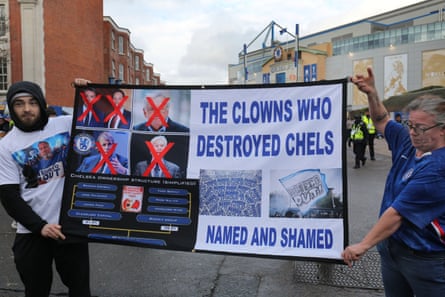
How did we get into a situation in which clubs are flotsam on the swirling currents of geopolitics and the world economy? Chelsea alone in the past four years have had a Russian oligarch forced to sell the club after falling under UK government sanctions, while a subsequent American co-owner has been forced to sell his minority stake after his insurance business came under federal investigation in the US. It's a curious world in which the professional gamblers feel like a welcome breath of fresh air.
The days of the local businessmen, the owners of mines, shipyards and factories, the hauliers and scrap-metal dealers, are gone. Some invested because they genuinely wanted to give back to their communities or liked the sport. Others did so because it was easier to fund a local football club than to improve working conditions or pay a proper wage. And some did so because, wrongly in most cases, they thought there may be money to be made.
But nobody should think those were days of purity. The decrepitude of English stadiums in the 1980s should caution anybody who thinks football was uncomplicatedly better then.
The contradiction has always lain at the heart of English football. Clubs represent their communities and for fans support becomes an aspect of identity, a link to family and place and past, a role that has only become more significant as the influence of traditional institutions – the church, the workplace, the social club – has faded. Yet fans in England have almost never owned their club, which in part underlies the present crisis.
That is not to say fan ownership is a panacea. There is much to be admired about the German 50+1 model which, to oversimplify, ensures outside investors can never own a majority of the club. But it has not prevented Bayern Munich from winning 13 of the past 14 Bundesliga titles. Some sort of recognition that a club is not just a business, that it has a community function might, though, have prevented the free-for-all that has led to this mess.
At least when most owners were local, there was some understanding of what the club meant to its area, and a recognition that exploitation or neglect could have direct consequences. No owner wanted demonstrations at the directors' entrance, or to be jeered as he drove the streets in his Rolls-Royce, or to have his car showroom boycotted because he put up ticket prices then sold a popular centre-forward at a knockdown price. The distant majority shareholder in his boardroom in Los Angeles, his penthouse in Monte Carlo or his luxury villa on the Gulf feels the sting less keenly.
Richard Scudamore, the former chief executive of the Premier League, who did more to shape the modern competition, for good and for ill, than any other individual always spoke of being "neutral about ownership models". Essentially that meant taking the money without worrying too much about where it came from. The current Premier League is the consequence: a gleaming, world-leading edifice, but built on what?
Perhaps it's not fair to be too harsh on the Premier League. This is not just modern football; it is modern Britain. As Miguel Delaney and Jack Pitt-Brooke argued on the Libero podcast this week, the Premier League is a direct outcome of Blairite economic policy, a point made clear in Oliver Bullough's Butler to the World In the book he described the classic New Labour approach as "allowing something, making money from it and attempting to solve the problems it causes after they've occurred".
But how do you solve those problems in football? How can football extricate itself from the clutches of the mega-rich? Regulation, up to a point, helps – and there may at least now be a sense that there can be enforcement. Whatever the flaws of the profitability and sustainability rules, or the squad cost ratio that has replaced them, it may be useful if football could accept the basic premise that the game shouldn't just be about how rich your owner happens to be. But that can only go so far; a door open to the world has admitted a world of problems.
Short of some sort of financial crash in football, the sort of apocalyptic event that would make the sport unappealing to big finance and require the game to be built anew, with a fresh spirit that might recategorise football clubs as community assets rather than simple businesses, we're probably stuck with it.
How, after all, could football ever escape the society that produced it?