ast one out of Wakefield on Saturday, turn off the lights. Some 965 days ago, this story began on a field in Siddal on the outskirts of Halifax with just a few hundred people there to see it: this weekend, one of rugby league's grand old clubs will be the headline attraction in front of more than 70,000 supporters when Trinity face Warrington in their maiden Super League Grand Final.
It is a rise so rapid it almost defies belief but to understand it, you must appreciate where this club were in the food chain even just a few short years ago. It was late 2023 when boyhood Wakefield Trinity fan Matt Ellis completed a takeover of the club; £10m worth of investment later, the results are clear to see on and off the field.
But at that time, Wakefield were a mess. Relegated from Super League in 2023, their famous Belle Vue ground was the laughing stock of rugby league; a crumbling, leaking relic with survival for the club seen as an achievement. When their new-look side took to the field at Siddal in the Challenge Cup in February 2024, few could have imagined what would follow: and at what speed.
Trinity sauntered to the Championship title, sealing an immediate return to Super League. Last year, they surprisingly reached the playoffs and this time around, they have reached the Grand Final for the very first time. Fifty-eight years on from their last league title and major trophy, Wakefield are on the brink of becoming the epicentre of the sport once again.
The boom is already astronomical within the town. Three years ago, Trinity's average crowds were below 5,000; this year, they have been over 9,000 and Ellis is already conscious that with around 20,000 supporters going to Old Trafford, Belle Vue may have to be redeveloped further to fit everyone inside in 2027.
But the signs are all over this rugby league-mad city, suddenly awoken from its slumber. You cannot drive anywhere without seeing Wakefield supporters young and old. Their Grand Final merchandise sold out before it had even arrived at the club shop. It used to be neighbouring Leeds Rhinos and, perhaps even Castleford Tigers, that were the talk round those parts. Now it is Trinity.
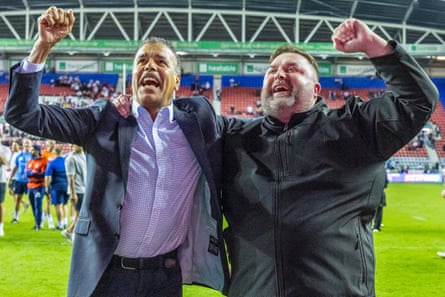
And for those who were on this journey before the riches rolled in, there is a deep sense of appreciation at where they have come from. "When I made my debut in 2008 they were talking about getting a new stadium back then, that's how long it's taken," Jay Pitts, who will retire after the Grand Final, smiles.
Pitts returned to Wakefield in 2020 after a decade away, and rejoined at a time when they were fighting for their very survival. "It wasn't a nice place to come," he admits. "The stadium was broken, everything was leaking … it was hard to get people through the door to come here. We just didn't have the finances to do anything. The club has had its issues, that's for sure."
The long-awaited planning permission to redevelop the stadium arrived in 2023, just as Wakefield were about to drop into the Championship after years of battling to keep their heads above water. That coincided with Ellis's initial investment followed by a full takeover and huge investment into the stadium and the playing squad.
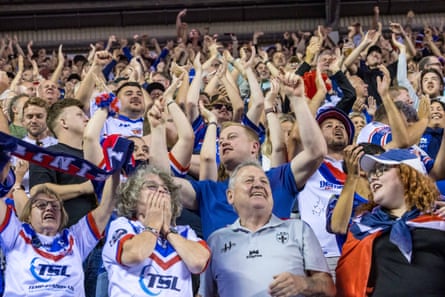
Before that, visiting players sometimes had to sit on plastic chairs on a makeshift bench. Players trained on surfaces barely fit for amateurs. "It was a bit of a shambles," Wakefield's winger, Tom Johnstone, who made his debut in 2015 and returned when they were promoted back to Super League last year, recalls of his early days.
"In 2022, our pre-season camp was on an army base in Sheffield but the weather was bad … so it just ended up a bit of a piss-up. Nobody really seemed to care about Wakefield Trinity. Now I'm walking my son to school, I've got people leaning out of their cars wishing us good luck. The whole city has gone crazy. It's unbelievable."
The story does not even reach Old Trafford without the tireless work and investment of the club's former owner, Michael Carter. He sold to Ellis in 2023 having spent the best part of a decade essentially trying to keep the lights on at Belle Vue, such was the state the club was in. He will be in the stands on Saturday evening watching on with pride.
And that is the thing about Wakefield. It is a city so deeply intertwined with its rugby league team that there are stories and heroes so easily overlooked and forgotten. Cult heroes who came before this group of potential legends. The volunteers who worked tirelessly to keep the club afloat during its many financial crises over the last 25 years.
None of this happens without the people of this city. Now, a new class of heroes including Johnstone and Pitts as well as Caius Faatili and Caleb Hamlin-Uele – both of whom were plucked from the Australian lower grades and are already Wakefield favourites – have the chance to follow in the footsteps of Neil Fox, Harold Poynton and Ian Brooke and emulate those heroes of the 1960s.
Since 1968, Wakefield Trinity have sat patiently in the shadows while others have enjoyed the limelight. This weekend, a remarkable sporting fairytale could have the ultimate ending: and there will not be a dry eye anywhere in the city if it comes to fruition.