f you don't like what is being said, change the conversation. Amid the wreckage of an epic midterm beatdown, the diminished president of the United States spent part of last week channeling another Donald when he publicly floated longtime aide-de-camp Dana White – the Ultimate Fighting Championship chief executive, Meta board member and public face of professional face-slapping – as the next White House press secretary. Trump's kayfabe featured a support team of UFC bruisers to help White keep the Washington press corps in line, a fantasy lineup that included Justin Gaethje, Daniel Cormier, Khabib Nurmagomedov and one "Kayla Harris". Surely he meant Kayla Harrison, the twice Olympic champion judoka from small-town Ohio who on Saturday night submitted the great Amanda Nunes in the co-main event at Madison Square Garden and made a credible claim for being the greatest female mixed martial artist the sport has ever seen.
Trump's turn to White's trademark bluster was a simple enough gambit to parse. In 2024, he rode the manosphere to an astonishing 63% backing among young white men, with White name-checking Joe Rogan, Theo Von, Adin Ross and the Nelk Boys from the victory podium like the heterodox heirs to Bill Buckley. Two years later, that support had cratered by 20 points in the midterms: the political equivalent of a 10-8 round. Suddenly, the prospect of White as some cauliflower-eared CJ Cregg seemed less like comic relief than a panicked attempt to inject a cycle of synthetic testosterone into Maga's increasingly low-energy movement.
For those whose weekends don't revolve around watching barefoot men and women kick and punch each other inside a steel cage, the performative West Wing sideshow doubled as native advertising for the UFC's annual November extravaganza at the Garden – where a sold-out house of 19,740 spectators, mostly men, was finally assured by late Saturday afternoon once the few remaining obstructed-view seats in the deep 200s were snatched up for $308.50 apiece at the box office. Yet beneath the gruesome theater of 13 fights over nearly eight hours that bled into the wee hours of Sunday morning was a question of political expediency. Rogan, the UFC's veteran color commentator and one of Trump's most powerful media allies, had gone conspicuously mum on the president before the midterms, to his measurable detriment. Was White's promotion, having tethered its fortunes so closely to Maga since 2016, contemplating a similar uncoupling now that the electoral winds had shifted?
In the parlance of Julia Masli: ha ha ha. There may have been fewer Maga hats and "YEW-ESS-AY!" chants than two years ago, when Trump feted his re-election cageside with Elon Musk and RFK Jr in his first appearance outside Mar-a-Lago. Yet any notion of a tactical retreat was scotched by the presence of Josh Hokit, who seized on his post-fight interview after a fight on June's card on the White House South Lawn to peddle a vulgar conspiracy theory about Michelle Obama – and told reporters on Wednesday he had no regrets, boasting that Trump amplified it on Truth Social. Five months on, he was rewarded with a heavyweight title shot in the main event where he drew the loudest cheers of the night before bowing on points to the French fighter and actor Ciryl Gane.
The UFC was hardly about to abandon its oldest instincts. From its earliest days as a pay-per-view curiosity derided as "human cockfighting", it has thrived on thumbing its nose at polite liberal consensus. Nowhere did the establishment resist more fiercely than here in New York, which banned professional MMA in 1997 and held out until March 2016 as the 50th and final US state to legalize it – and even then only after Democratic assembly members called it "a terrible, nasty, violent sport" and "a sad day" before reluctantly giving it the green light.
Three decades on, the promotion has turned cultural defiance into a slickly marketed juggernaut valued at more than $12bn, having cultivated the manosphere years before it had a name and given middle America a roster of homegrown heroes that boxing, its older and superior cousin-sport, increasingly struggled to provide. One industry executive described the UFC's core audience to the Guardian as "white guys from the suburbs who grew up watching pro wrestling and aren't married yet" – a demographic that would soon become one of the most coveted constituencies in American politics. The distance traveled from outlaw attraction to establishment property was underscored when Paramount Skydance, days after a highly scrutinized merger approved by Trump's regulators, committed $7.7bn (£5.8bn) over seven years for its US broadcast rights.
White spoke at three Republican national conventions, defiantly brought the UFC back in May 2020 as the first major US sport to resume amid the Covid-19 shutdown, and in June staged a fight card on the White House grounds to mark the nation's 250th anniversary and Trump's 80th birthday, absorbing an estimated $30m (£22m) loss in the process. Having long served as a recruiting and morale vehicle for the US military, the UFC has seen its political and national-security ties become fully institutionalized: a proposed no-bid contract to train FBI agents under Trump loyalist Kash Patel, a state department sports-diplomacy agreement and a sponsorship deal with defense-tech contractor Anduril.
There is plenty to loathe about the UFC's playbook even beyond its cozy synergy with Maga pageantry: its resistance to unionization, its intimidation and blacklisting of journalists, its stranglehold on fighter pay, which accounts for a smaller share of overall revenue than in any other major sport. (Only men's tennis, where tensions over prize-money splits are approaching a breaking point, comes close.) Yet seeing Harrison's name in lights in Times Square and throughout midtown Manhattan all week for one of the most consequential women's bouts in the promotion's 33-year history, it was also impossible to ignore the UFC's most consistently redeeming quality: it has created a path to real money and celebrity for Olympians who devoted their lives to punishing sports that for years offered neither once the medals are handed out.
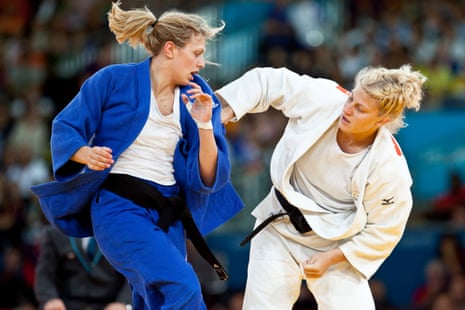
Few pieces of media have captured the lonely afterlife of Olympic glory more brutally than the opening five minutes of Bennett Miller's 2014 drama Foxcatcher. The film shows Mark Schultz (played by a never-better Channing Tatum), the 1984 Olympic wrestling gold medalist in training for the world championships and the 1988 Games, delivering a motivational talk to a roomful of fidgety schoolchildren for a $20 check before smash-cutting to him waiting in a fast-food line and eating a burger alone in his car. For decades, that was the bargain struck by American wrestlers: sacrifice your youth to one of the world's most unsparing disciplines, reach the absolute pinnacle only to discover that your life's work has earned you neither a living nor an audience. Schultz himself fought at UFC 9 in 1996, becoming the first Olympic gold medalist to enter the octagon. At least 20 more Olympians have followed, mostly from wrestling and judo with a splash of taekwondo, including medalists like Ronda Rousey, Sara McMann, Yoel Romero, Henry Cejudo and Harrison, as the promotion gradually opened a genuine avenue to wealth and celebrity their original sports could scarcely offer.
None of this should allow White to be retconned into a trailblazer for women's sports. Unlike Jake Paul, of all people, an unlikely ally who has spent years putting his ample fortune and promotional muscle behind female boxers, White flatly insisted in 2011 that women would fight in the UFC, before finally seeing the light on the virtues of gender equality once Rousey became a bankable box-office attraction for a rival promotion. Even so, while the UFC's ruthless business practices and Maga mien may offend their sensibilities, the spectacle of two baddies co-headlining a card that pulled in a $10.3m (£7.8m) live gate was enough to warm the hearts of everyone with an emotional investment in women's sports from Billie Jean King to Coach Jackie.
For Harrison, the opportunity was transformative. Without the UFC, she might well have vanished into that quiet anonymity that swallows countless Olympians, her extraordinary story confined to a few niche sports pages and a two-week quadrennial window – even then at risk of being preempted by gymnastics, swimming or a Ryan Lochte gas-station scandal. Born in Middletown, Ohio – the same deindustrialized Rust Belt city that gave America vice-president JD Vance – Harrison was sexually abused as a teenager by her judo coach, Daniel Doyle, leaving her battling depression and suicidal thoughts. She went on to become the first American woman or man to win Olympic judo gold at London 2012, using her newfound spotlight to speak more openly about the abuse she had first disclosed before the Games in a powerful Sports Illustrated cover story.
Life kept landing blows. Her father took his own life in 2014, two years before her repeat gold in Rio. When her sister struggled with addiction, Harrison's mother and stepfather took in her two young children. But after her mother suffered a stroke and her stepfather died in 2020, Harrison took over their care, eventually adopting them. By then she had overcome her initial disdain for MMA, trading the judo mat for the cage and winning two Professional Fighters League championships while navigating single motherhood. As she put it early Sunday morning in the bowels of the Garden, raising two kids leaves little room to dwell on dark days: "You still gotta open the bag of chips for them. Like, you wanna sit and cry on the floor, but they're like, 'Mom.' I'm like, 'Okay, guess I'm not gonna have a breakdown right now.'"
She joined the UFC in 2024 and needed just three fights to claim the bantamweight title once purpose-built for Rousey, submitting Julianna Peña 17 months ago. That set up Saturday night's showdown with Nunes, her former training partner and the most decorated female fighter in UFC history coming off a three-and-a-half-year layoff. Harrison, now 36 and returning from career-threatening neck surgery that derailed their January meeting, admitted she would have gladly fought Nunes behind closed doors. The fame held little appeal beyond the platform it gave survivors of sexual abuse to find her Fearless Foundation.
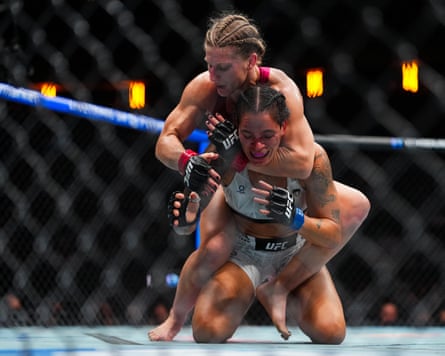
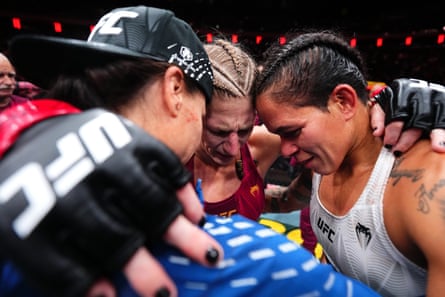
On Saturday night, the clean, clinical judo that had first brought Harrison Olympic glory proved decisive all over again. Nunes bafflingly abandoned her advantage in the striking exchanges to grapple with the master judoka. She had Harrison wobbling in a frantic opening round, only to surrender dominant position after a beautifully executed throw. The pattern repeated in the second, with Nunes inexplicably pursuing takedowns before finding herself pinned beneath Harrison. By the third, Harrison's fatigue was beginning to show, but Nunes had already allowed the champion to dictate the terms. In the fourth, Harrison finished the argument with a rear-naked choke applied with the sudden, predatory speed of an animal attack in an Attenborough documentary, forcing Nunes to tap. Afterward, Harrison crouched at the center of the octagon before dropping to her knees, looking for a moment as though she might cry. Instead, she seemed to find a moment of peace.
That platform simply does not exist in the insular world of American judo. By stepping into the octagon, she turned amateur-sport obscurity into main-event money, a place in the US sporting mainstream and her name and likeness on the marquee of the world's most famous arena. Asked what her 13-year-old self would make of it all, Harrison laughed: "She wouldn't believe me. She'd be like, 'We did what? We do MMA? What? Like, we made how much money?'"
Harrison's triumph under the bright lights of the Garden offered the clearest distillation yet of what the UFC is: a company stubbornly wedded to its rightwing bravado, a business model built on ruthless self-interest, and, right at the center of the cage, a woman who survived everything life threw at her finally getting paid – and seen.