
Captain Harmanpreet Kaur’s legacy will be very difficult to emulate.
Time seemed to stop when Nadine de Klerk sliced the ball towards extra cover on the night of the 2025 World Cup final. Had it been a movie, the editor would have taken the liberty to play the next few seconds in slow motion, punctuating the arc of the ball with flashbacks from the past. As far as fairytale finishes go, it is difficult to improve on that World Cup ending with Harmanpreet Kaur holding the final catch. For it was she who had been at the helm during Indian women’s cricket’s journey from adolescence to adulthood.
Of course, she wasn’t alone.
Kaur could run because Mithali Raj and Jhulan Goswami had walked, and because Shantha Rangaswamy, Diana Edulji, Sudha Shah, and Shubhangi Kulkarni had stood up half a century ago. She knew that better than any of us, which was why she invited Raj, Goswami, and Anjum Chopra to join the victory celebrations that night. But few have witnessed a metamorphosis in Indian cricket as profound as Kaur, a substantial part of which was as captain.
Harmanpreet Kaur began in the ancient era of Indian cricket for women, bossed its medieval era, and held her head high as she oversaw the transition to modern cricket.
You may deny that claim, given she is only 37, still active, and was the first woman to lead India to a senior World Cup title less than a year ago – all of which screams to deny that “ancient” tag. But that ignores the fact that over Kaur’s career, time in Indian women’s cricket moved at breakneck speed, at a pace not usually associated with the sport.
Kaur first led India at the 2012 Asia Cup, the first T20 edition of the tournament. She stepped in first for the injured Raj against Hong Kong, then again in the final against Pakistan. This was truly an ancient time for the women’s game – that same year, Kaur had played a T20I against the West Indies where no one kept track of how many balls the batters faced. That is why, on any website, Harmanpreet Kaur’s profile page does not mention her T20I career strike rate.
This is not the only reason to call that an ancient era, as the team’s tactics have also rapidly evolved. India Women’s scoring rate has changed at an astonishing rate over the years, and Kaur, “India’s first proponent of modern power hitting”, was key to that. She led India to success they had never known in T20Is and later, did the same in ODIs.
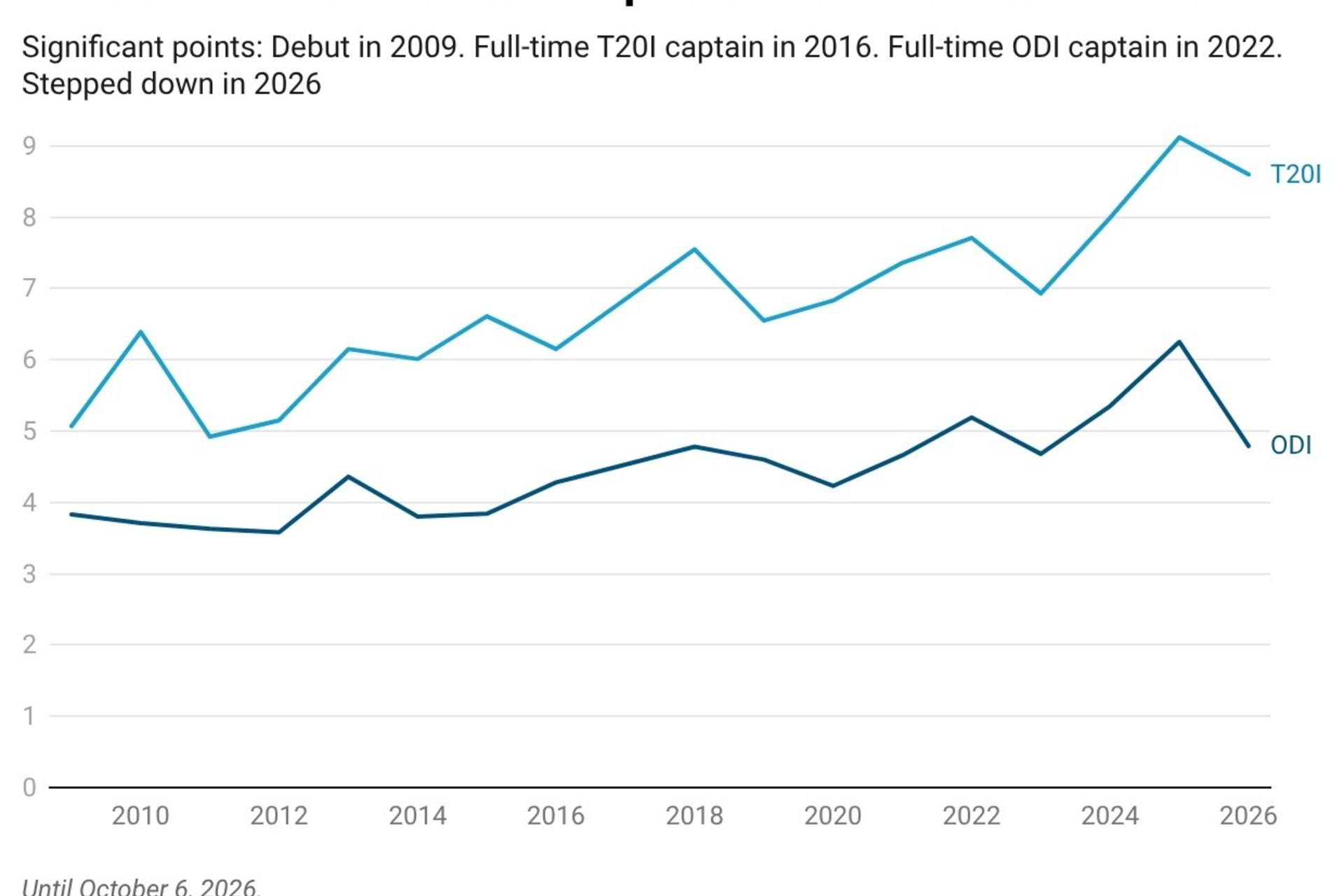
Her outsized impact can be seen across all three formats.
Of India’s 233 T20Is, she has led in 155. That latter count is a world record, as are her 92 wins. In the format, she was not merely India’s longest-standing captain: the Kaur Era represents the entirety of India’s T20I history in the women’s game. In ODIs, she led India Women to their first ever senior World Cup title. And in Test cricket – now reduced to a token format in the women’s game – she is the only non-Australian captain to win Tests against three different teams.
When Kaur took over, India were always above par in Asian cricket, but had their struggles against Australia, England, or New Zealand. Against these three, India were expected to just compete. Defeats, when they were noticed, were seldom criticised.
During the Kaur Era, South Africa also rose as another strong opposition. But despite that, the expectations had changed drastically for Kaur’s side. India are now expected to win everything, and are subjected to brickbats at every defeat.
There was one obvious, canary yellow reason for this backlash.
Kaur’s India had stumbled several times at global T20I tournaments, but almost every time at the same block. In the 2020, 2023, 2024, 2026 T20 World Cups and the 2022 Commonwealth Games – that is five times in a row – India were knocked out by Australia. Of course, India’s bane just happens to be the greatest team in the history of the women’s game. Kaur can take solace in the fact that only the very best side has repeatedly prevented India from World Cup glory in the shortest format.
Through it all, Kaur has always led from the front both as a player and captain. She kicked off her first T20 World Cup with a hundred, then beat Australia before crashing out against England. It had been India’s best tournament until that point, but the headlines were dominated by Kaur’s decision to drop Raj from the playing XI – a very unIndian act. But she emerged from that controversy to lift India to their first ever final in 2020.
Two years after that, when Deepti Sharma’s run out of Charlie Dean at Lord’s caused a furore, Kaur backed her teammate to the hilt at the post-match presentation.
Yet, in the Kaur Era, India Women’s transformation was not restricted to the field. In 2016, she became the first Indian woman to play in the WBBL and, by extension, in any overseas T20 league. She made sure to make that opportunity count, winning Player of the Tournament in her first season, and was promptly retained.
She was the T20I captain by the time Indian women got their first BCCI central contracts, in 2018. That year, she was one of the captains at the Women’s T20 Challenge, the mini-tournament that later expanded to the WPL. And when the WPL began, she became its first captain to win it.
Even if Kaur did nothing else, she would have had her place in history for that knocked Australia out of the 2017 World Cup. It had not even been a year since she had been appointed T20I captain. That innings made the viewership for the final go through the roof, and inspired revolution for the women’s game in India.
But Kaur’s contribution transcended even that. In an era of increasing attention on conventional and social media, she converted women’s cricket in India from a curiosity to a cultural phenomenon.
As the women’s game took off in India, the likes of Raj and Goswami had made generations of Indian girls pick up cricket kits and aspire to become professional cricketers. Kaur took up the baton, and her legendary run at the top made them dream of becoming world champions.
And that legacy is going to be right up there, along with that World Cup trophy.
Follow Wisden for all cricket updates, including and more. Stay up to date with the .