Before a single vote was cast this election cycle, the technocrats and oligarchs who own American sports had already voted. Pro sports owners put more than $100m into this cycle, according to Front Office Sports. But Tuesday night was a referendum not just on Donald Trump and Maga policies, but on the puppeteers who pull America's strings. The people voted, and the owners lost.
Before anyone frames this as a rescue, a word about the rescuers. Democrats are the instrument for ending Maga, and they are also the other face of the same coin. Think Republicans are behind all of our ills? Think again. New Jersey's governor, Phil Murphy, placed his state's first legal sports bet in 2018. Illinois governor JB Pritzker signed sports betting into law a year later. New York's mobile sportsbooks went live under Governor Kathy Hochul in 2022, with the state taking 51% of the revenue. Pritzker and Hochul both won Tuesday, and all of them are Democrats. In some of the biggest betting markets in the country, the bookmakers' most reliable partner has been a Democratic statehouse.
Having said all that, the biggest losers on Tuesday night were Republicans: Democrats flipped both chambers of Congress. That would have made plenty of sports owners disappointed, as they have a habit of backing Republicans. At least 10 sports owners backed Mike Rogers in Michigan, and Abdul El-Sayed beat Rogers. Dallas Cowboys owner Jerry Jones gave $1m to Trump's super Pac and $250,000 to a committee backing Ken Paxton, andJames Talarico beat Paxton in Texas.
The former Mavericks owner Miriam Adelson lapped everyone with at least $67m to Republican committees, in keeping with her history of big spending around elections. What did she get for her money? A House and Senate minority.
So how does all this affect the future of American sports? Let's count the ways.
The NFL spent a decade teaching its fans to bet, and on 8 October it asked the US supreme court to help protect those fans from prediction markets. The league's brief makes two arguments: prediction markets are gambling that belongs under state regulation like any sportsbook, and the money is enormous. Football drew $1.8bn in prediction-market trades on the season's opening Sunday, more than half of everything traded. Kalshi takes customers at 18, three years younger than legal sportsbooks allow in many states.
Here's the catch: the regulator the NFL is fighting answers to Trump. The Commodity Futures Trading Commission (CFTC) has sued at least nine states to stop them from applying their gambling laws to prediction markets, and Donald Trump Jr advises Kalshi. Utah's attorney general, Derek Brown, filed 13 felony counts against Kalshi and its two co-founders for taking sports bets from an undercover agent. The league's owners spent $20m electing the party whose administration filed those suits.
Democrats will control confirmation of the next CFTC commissioners, and they wrote most of the roughly 30 prediction-market bills in this Congress. That's a turf war over which bookmakers get the money, and the party that built the licensed ones now protects them from the new ones.
Nebraska rejected online sports betting by 54% to 46% after the sportsbooks' committee outspent the opposition by 20 to one, according to the opposition. Nebraskans saw a casino on every teenager's phone and voted no. Strip away the branding, and this is straight-up degeneracy with a licensing deal: a league taking a cut of its own fans' losses and calling it engagement. The industry's next request to the lame-duck Congress is to restore the full tax write-off for gambling losses that Republicans capped at 90% last year.
The Bears want Illinois taxpayers to help pay for a new stadium, and on 1 October, the NFL commissioner, Roger Goodell, sat across from Pritzker and told him the state had to act now as the team also strongly considers building its new stadium in Indiana. Pritzker, a billionaire Democrat who won a third term on Tuesday, wants the legislature to vote in its autumn veto session, on 17–19 November and 1–3 December.
That session begins two weeks after the election, when voters can no longer take their votes back. In Washington, the president first threatened to scuttle the Commanders' $3.8bn RFK Stadium deal unless the team brought back their old nickname, then spent the rest of the year trying to get his own name on the building. These deals move money from people who will never afford a club seat to the family that owns the team, and both parties co-sign them.
The WNBA just had the best month in its history. Game 7 of the finals, in which the Golden State Valkyries beat the Atlanta Dream, drew 3.3 million viewers in the first season under a new seven-year labor deal. Four states also voted on who plays women's sports. Arizona approved Proposition 318, which requires schools to assign teams by biological sex. Nebraska passed a similar measure with 67% of the vote and put it in the state constitution. Washington's Initiative 638 held a wide lead on Wednesday morning, and Colorado's Proposition 134 led narrowly.
The supreme court allowed states to enforce those measures on 30 June, ruling 6–3 that states may bar transgender girls from girls' teams and that nothing requires them to do so. The 30-year-old league's own rule is one laconic sentence in that labor deal: "Only players who are women are eligible to play in the WNBA."
The NBA commissioner, Adam Silver, has spent a year asking Washington to clean up a mess he helped create with the 2014 opinion piece that pushed legal betting into the mainstream. Since federal prosecutors in Brooklyn charged Chauncey Billups and Terry Rozier last October, that office has indicted at least five NBA figures on gambling-related counts. Silver wants Congress to pass a single federal betting law and wants regulators to provide the league with prediction-market trading data.
A league that needs software to monitor its own players' wagers has already lost the argument over whether wagering belongs near it. Silver gave about $41,000 to Democrats this cycle, Adelson gave $67m to Republicans, and only one of them got what they paid for. The party Silver backed has never met a regulated betting market it wouldn't tax, so expect it to hand him the framework he wants.
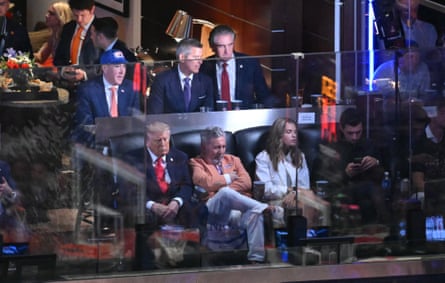
Then there's Madison Square Garden. The Knicks' home arena pays no property tax and sits above Penn Station, which is set for an overhaul of around $8bn, much of which the federal government will likely pay for. The Trump administration pushed New York's Metropolitan Transportation Authority out and handed the project to Amtrak, which chose the plan that leaves Madison Square Garden where it is. James Dolan hosted Trump's rally there nine days before the 2024 election and put him in his suite for Game 3 of the NBA finals three weeks after the Penn Station decision.
The arena's 1982 tax break had cost the city nearly $1bn by 2023. Only Albany can repeal it, and Albany belongs to Hochul. She won re-election on Tuesday and has never laid a finger on Dolan's tax break. This is the governor who put $850m of public money into a Buffalo Bills stadium, the largest stadium subsidy in NFL history, while her husband served as general counsel of the company that runs the Bills' concessions. Both said he recused himself. The Knicks are defending champions. Dolan is undefeated. Sadly, so is the arrangement.
College sports
The Senate's college sports bill protects women's programs, but Cory Booker, the Democratic senator from New Jersey, fought it because those protections expire after nine years and the NCAA's antitrust exemption never does. The House speaker, Mike Johnson, said he would bring it to a vote even if Republicans lost the House, and they did. The House minority leader, Hakeem Jeffries, now in line to be the first Black speaker, has not said whether he will. How convenient.
Owners and players
The owners, as usual, are less ambivalent than the players. Tilman Fertitta, the Houston Rockets owner and US ambassador to Italy, bought the Connecticut Sun in May and gave $200,000 to the Republican National Committee. Josh Harris gave $255,000, almost all of it to a Republican Senate Pac, and his partner David Blitzer gave more than $150,000, mostly to Democrats. One ownership group covered both parties. Do you see it yet? This is how the donor class always wins. The last time the Atlanta Dream franchise got into a Senate race, their players wore "Vote Warnock" shirts and helped defeat their own co-owner, Kelly Loeffler, who now runs the Small Business Administration for Trump.
Kalshi took more than $1.4bn in bets on the election itself and has hired a lobbyist with ties to the man now in line to be speaker. The owners lost on Tuesday, but they'll be fine because the people who own your team gave to both parties, and so did the bookmakers. The Democrats who won will investigate what deserves investigating and then go back to signing stadium deals and betting bills. Remember, this is by design.