ver the weekend, 11-year-old Bodhana Sivanandan became the youngest ever holder of the title of woman grandmaster at the Chess Olympiad in Uzbekistan – while playing on a car booster seat so she could reach the board. By Tuesday morning she was back at school in north London for a design and technology lesson.
Bodhana has to juggle the competing pressures of being an international chess sensation with the more ordinary challenges of childhood and her first term at secondary school.
She takes it all in her stride. "I'm used to going to tournaments and then coming back to school the next day," she told the Guardian in her first interview since returning to the family home in Harrow. "Now that I'm in secondary school there might be more homework, but I should be able to manage."
She has won three smartphones at various tournaments but she is still too young to be allowed to use them. "One day I'd like a phone, but I'm fine without," she said. Sitting beside her, her father, Sivanandan Velayutham, who works in IT, added: "I don't think it is the right time for her to have a phone."
Bodhana's meteoric rise up the chess rankings suggests she is thriving without the distraction of social media, even if it means missing congratulatory posts from her growing fanbase including Rachel Reeves, Rishi Sunak and the children's commissioner, Rachel de Souza.
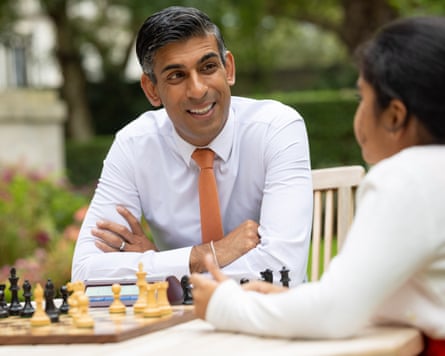
Competing in Uzbekistan meant the family had to secure an authorised absence from her new school and she will have to catch up on a fortnight of missed classes. But Bodhana is a fast learner; her father taught her to play chess when she was five, and within a year, and with the help of YouTube videos, she was beating him.
When she was seven, Bodhana won 5-1 playing simultaneously against six members of her local Harrow chess club. At eight she managed to beat the former British champion Peter Lee. In July she became the youngest girl to beat a grandmaster with a rating of over 2,600, and she was the youngest person ever to be selected for an England team in any sport.
Bodhana's latest victories in Samarkand give her a rating of 2,382, surpassing the required 2,300 points to become a woman grandmaster. She is just a few points away from the 2,400 required for international master status and needs 2,500 points to be an outright grandmaster. If she achieves that in the next 11 months, she will become the world's youngest ever grandmaster.
Bodhana is not aware of that deadline. "I want to become a grandmaster as soon as possible, but I'm doing it because I like it, not to just chase records," she said.
Her ambition is simply to be the best player in the world.
Nigel Short, one of Britain's best ever chess players, was roundly criticised in 2015 for claiming men's brains were hardwired to be better at chess than women. Bodhana has other ideas. She said: "By rating, yes men are better than women, but a woman could also achieve the same thing if they work hard enough, so I don't agree fully."
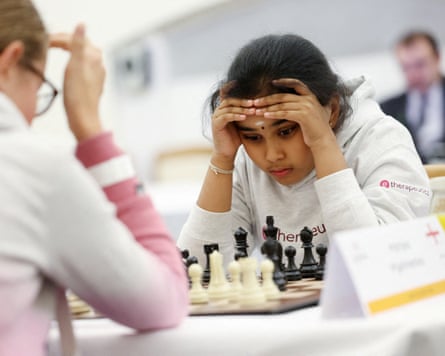
She took on the current world No 1, Magnus Carlsen, in a game of speed chess earlier this year. "It was a blitz game, and I lasted about 10 minutes. No one likes losing, but losing is kind of necessary to learn."
Bodhana has a fearless approach to chess. "I don't get nervous, but even when I do, I just try to focus on the game and forget about everything else," she said.
Jonathan Eckert, 67, a keen tournament player, could only manage to draw against Bodhana when she was six. "I was fairly confident of winning, but she played the endgame extremely well, which is the sign of a classical player. A lot of these youngsters are incredibly good at tactics, because they're playing against computers all the time. I was quite surprised she was battling with me on strategy."
Bodhana is used to being praised on her classical play and positional sense. "Lots of people say that about me. It means you don't play very sharp tactics, but I can also do that if I need to."
The booster seat can help unnerve opponents. "Sometimes it distracts them, but I don't know if it freaks them out," she said.
Her favourite player is José Raúl Capablanca, a Cuban world champion from the 1920s whose books and games she has studied. "I like the way he plays in his endgames," she said.
Away from chess, Bodhana enjoys playing the piano and violin, and reading. She does not watch television because she does not have time; she has eight hours of chess tuition a week paid for by English Chess Federation and the Chess Trust.
Her father is keen to add that the family is also grateful for sponsorship from the Turkish investor Evren Üçok, Tangram Therapeutics and the John Robinson Youth Chess Trust.
Bodhana's next nine-day tournament could be the London Chess Classic at the end of November, but only if it fits in with school and the schedules of her parents and younger twin sisters. "If good tournaments come up we try to work it around," said her father.
"We're not pushy, we just work on our goals and keep going. Opportunities are scarce in this world. You have to understand your kids and know what they like and allow them to shine."