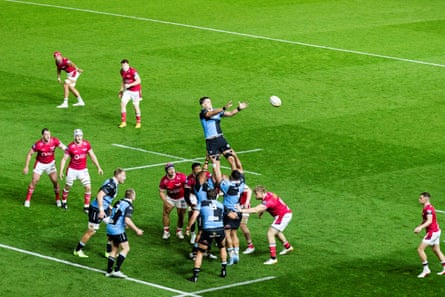
ight o'clock, Saturday night and at Parc y Scarlets the fans are starting to sing. Their scrum-half, Dane Blacker, has just come skipping through half a gap in the Cardiff line. Blacker has slipped the ball on to their loping lock, Sam Lousi, who has flicked it out the back of his hand to the centre Joe Roberts. And Roberts has juggled it up from one hand to the other, gathered it back in and gone sprinting in to score in the corner. They're leading 5-0 and in the stands it's and Hymns and Arias and "Scarlets! Scarlets! Scarlets!"
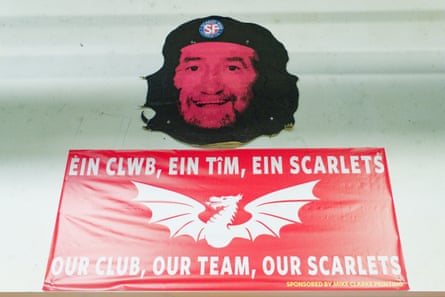
And somewhere in among it all, reports will say later, a new chant too – "Dave Reddin's a wanker".
Reddin, director of rugby at the Welsh Rugby Union and self-identified "serial disrupter of elite sports performance", has just recommitted to the union's grand plan to scrap one of the four regional teams. Cardiff, who are owned by the WRU, have been told they are safe, and so have the Dragons, who play out of Newport. Which leaves the other two teams, Scarlets and Ospreys, fighting for one slot.
"I understand the pain," Reddin said. No one here believes him, any more than they would a doctor who warns that the amputation he's about to perform may sting a bit.

Out in the west, what they most want to know is why the Scarlets and Ospreys, two teams who have won titles, turned out hundreds of Test players, and who, unlike Cardiff and Dragons, have never been into administration, have been told they are the ones who have to give. It was only 18 months ago that the WRU publicly committed to maintaining all four teams. And it was 12 months ago that they announced they were going to get rid of two. Six months ago they decided to keep three.
Nigel Davies, the club's director of rugby, says: "It's all so random at the moment, isn't it? We've gone from four, definitely, to two, to three. I mean, it would be unacceptable in any other walk of life. That is not planning. That is chaos."
Simon Muderack, Scarlets' chairman, says: "To be blunt we're not going anywhere. It's only by looking around their patch that you can really understand what he means. Parc y Scarlets, built in the early 2000s, seats 15,000, and has its own indoor and outdoor training facilities. The whole place is owned by the club."
Davies sighs when he says: "I don't know what they think we'll do with this place if there's no one to play here."
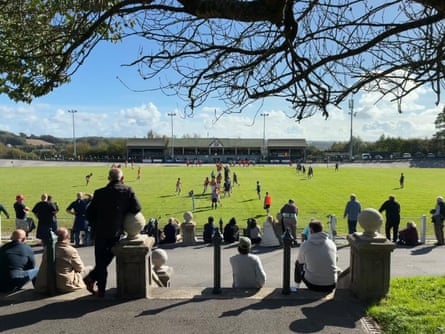
The stadium was the work of Muderack's predecessor, Huw Evans, who oversaw construction when the Welsh clubs were being consolidated into regions. "It was a fight to the death really," Evans says, "and building this place was our survival strategy." It still is. Evans is back at the club for the Cardiff game to take part in a ceremony honouring former Scarlets players. The club are giving individual cap numbers to every one of the 2,600 who have played for them. Derek Quinnell is there, so is Dwayne Peel, the current head coach, so is Davies himself.
The players being honoured came to the club from all across west Wales. Scarlets has always been a little different because its patch is so big. As they like to say, it's the west's team, even though the stadium is closer to the English border than the western coast. Pembroke, Cardigan, Aberystwyth, even Llareggub, they're all part of the club. Earlier in the day I am up at Carmarthen, where Quins are playing Swansea in Super Rygbi Cymru. There's a crowd of 250 or so. The Quins side has eight Scarlets players in it, most of them still kids.
"People in this region have always looked to the Scarlets as their team," Davies says. "When I was a boy growing up, I wanted to play for the Scarlets, yeah, Wales would have been good, but Scarlets was the team, that's what got me into rugby."
The club's managing director, Jon Daniels, is Llangennech-born and bred. "Rugby's in people's blood here, has been for 150 years." His grandad used to be in the steelworks. "When I was born this was all mines and works steel, tin, and all that gave us a real strong sense of community."
Daniels says Scarlets are the last part of it left standing. "What we are is west Wales. The day our community thinks they no longer need the Scarlets, that's when we're done," he says. "The industry's gone, the manufacturing's gone, the mines are gone. Without the rugby, all it would become is a lovely place for people to come and visit on their holidays." The club, he says, are "here to show the young people that they can be from a little village in west Wales and be world-class."
Their fight isn't with the Ospreys. "Ask anybody here, they want Ospreys to be around," Davies says, "and ask anybody there, they will say the same about us." It's not even with Cardiff, or Dragons. It's with the WRU. Muderack says: "I don't really see how not going bankrupt can get you penalised. I struggle with that. It doesn't sit well with me. And I don't see how being the only holders of the main domestic league titles can get you penalised, either."
There's only 15 miles or so between the two, and there have been times in the past when they've come close to a merger. "I would never say never," Muderack says now. "But I think the world has moved on from that now. And what I certainly don't think makes any sense at all is a new franchise. Along the lines of a West Wales Warriors."
Davies says it is like these decisions are being passed down from an "ivory tower", it's an existential threat imposed, with no explanation, by people who don't live in west Wales, and who, they say, haven't taken the time to understand it. A series of workshops on all the cuts are due to start in December, but Muderack says there are no conversations going on now. "I mean, our primary communication mechanism at this point has been the public domain."
No one here is going to argue that Scarlets are getting everything right. The club is sustainable day-to-day, but it carries a lot of debt. What they have, in abundance, is people who care. And when they're threatened, they will fight. The club have just brought the former first minister Carwyn Jones on to the board. "Scarlets will always have people that look after it," Muderack says. "I've been here six years, and in that time I'm going to be on my fifth WRU chair, and my fourth WRU CEO."
Muderack is convinced that the answers ought to include more fixtures against the English teams, and more effort to draw in private investment. All this uncertainty makes both almost impossible. Daniels says: "It's very difficult to have a straight story for our fans, for our sponsors, and our community."
So they press on as best they can. "Welsh rugby is in a tough place. Not just because of decisions made yesterday, but because of decisions made 10 years ago. And it might take another 10 years to get out of it. But it has to start with an open and honest conversation about what the real position is. And that conversation has to start with: 'What do we have to do to keep four teams?'"