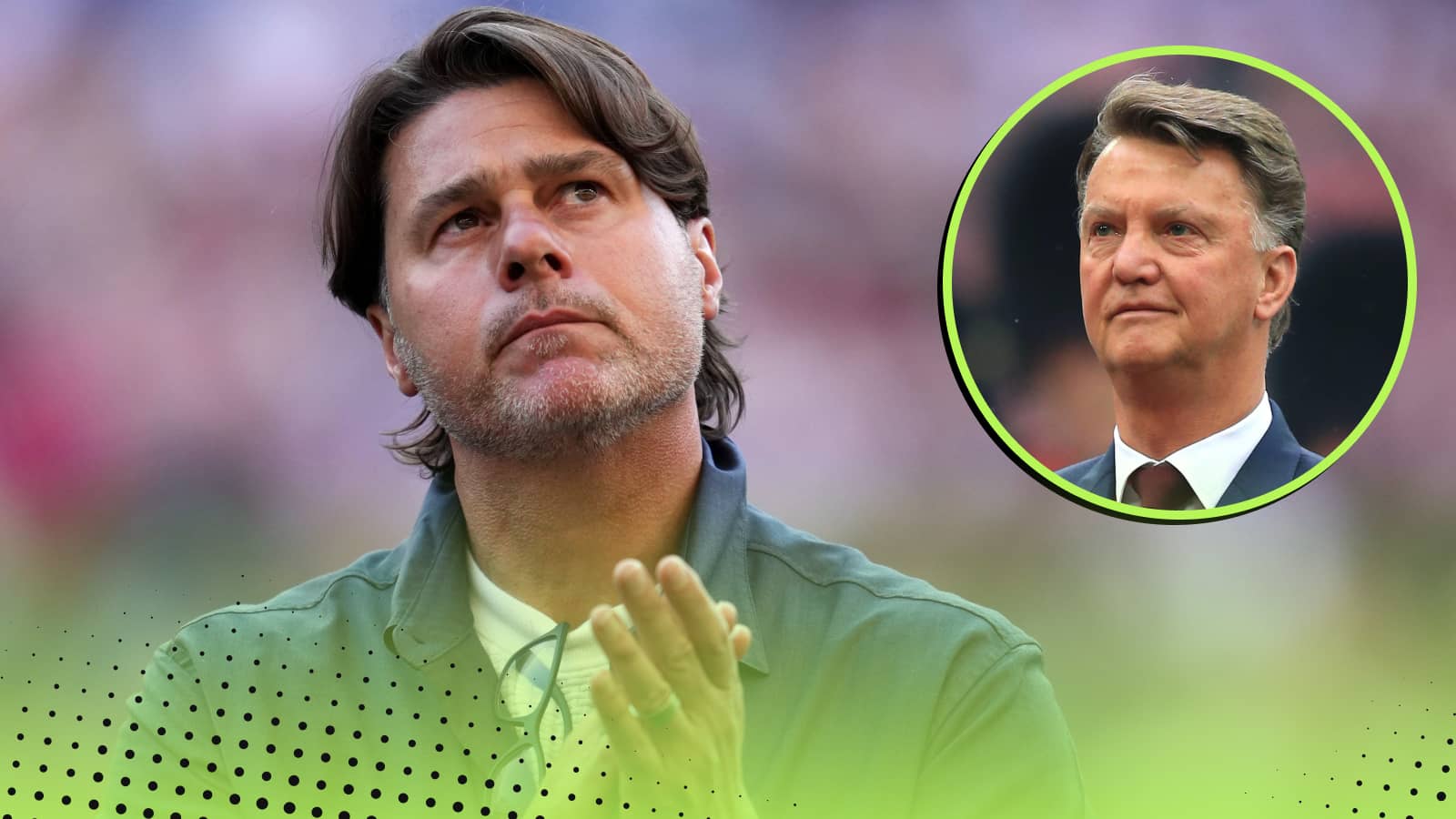
Like a stuck record, Manchester United are looking at Mauricio Pochettino again as they seek a replacement for Michael Carrick.
He caught their attention before with his impressive work at Tottenham Hotspur, having originally made his name in the Premier League with Southampton.
But these days Pochettino isn’t managing day-to-day. He’s currently in charge of the USA, who he led to the World Cup round of 16 this summer.
If United go for Pochettino as their Carrick successor, they’d have to hope he could make a seamless transition back into club management. It’s a different ball game, let’s be honest.
But it’s a transition several managers have made before. Working backwards, here are the last 10 managers to be appointed by a Premier League club when their previous job was in charge of a national team.
Roy Hodgson (Crystal Palace after England, 2017)
After the disaster of England’s Euro 2016 exit to Iceland, the experienced Hodgson remained out of work for more than a year.
You wouldn’t have blamed him if he said that was that. He was approaching his 69th birthday at the time and could look back on a well-travelled career.
But Hodgson had more in the tank. In September 2017, he got the call from Crystal Palace – the club whose academy he had played in as a youngster decades before.
Palace had just got rid of Frank de Boer after his shocking start to Premier League management. They needed someone who knew what they were doing, fast.
Over the next four years, Hodgson did a fine job of stabilising Palace. Taking over when they were bottom of the league, he steered them to 11th place by the end of the season.
A 12th-place finish followed in his second season, before back-to-back campaigns where they finished 14th. Palace were midtable safe bets.
They moved on from Hodgson in 2021 as bigger ambitions took hold, but they turned back to him for a second spell in charge between March 2023 and February 2024.
Sam Allardyce (Crystal Palace after England, 2016)
What is it with Palace and appointing these former long-serving (ahem) England managers? Gareth Southgate to replace Pierre Sage, anyone?
Allardyce was chosen as Hodgson’s successor for England in 2016, but famously only got to manage one game before having to step down after a newspaper sting.
Seemingly impressed by his 100% win rate, Palace chose him as their replacement for Alan Pardew that December.
The Eagles were hovering just above the relegation zone at the time. Allardyce briefly took them into it but lifted them out by the time it mattered, guiding them to 14th in the final standings.
Former Juventus boss Conte got the itch to get back into club football after two years in charge of his native Italy, who he took to the quarter-finals of Euro 2016.
By then, he already knew the Chelsea job was waiting for him after an announcement in April.
Conte took to his new role like a duck to water. Implementing his tried and trusted back three system, Chelsea stormed to the Premier League title at the first time of asking.
However, the second season of Conte’s spell at Stamford Bridge wasn’t as successful. They went one better than the season before by winning the FA Cup, but fell to fifth place in the league.
It was enough for Conte to get the sack, even though Chelsea had to pay out more than £20m to him in compensation.
After a year out, he returned to Italy to take charge of Inter Milan in 2019. Chelsea stuck to the Italian theme by naming Maurizio Sarri as his successor.
Before Conte’s arrival, Chelsea had seen out the 2015-16 season with Hiddink as their interim manager after parting ways with Jose Mourinho.
It was Hiddink’s second stint with Chelsea. His previous had been in 2009 alongside his duties as Russia manager and this time came half a year after his reign with the Netherlands ended.
He enjoyed a 14-game unbeaten run in the league to lift Chelsea away from bottom-half obscurity and into midtable. They finished 10th, but failed to replicate the FA Cup-winning success of his first spell.
Hiddink never managed a club again. His next job was in charge of China’s U23/Olympic team before he finished his career with a spell in charge of Curacao.
Claudio Ranieri (Leicester City after Greece, 2015)
Yep, this one went pretty well.
Ranieri was in charge of Greece for just four games, winning none, before being sacked in November 2014. When Leicester appointed him the summer after, most people wondered what they were thinking.
Probably not of winning the Premier League, that’s for sure. But we all know what happened next. Legendary.
Advocaat has been a well-travelled manager who you probably remember more from being in charge of countries than clubs, unless you’re a fan of one of his former employers like Rangers.
He’s spent time in charge of the national teams of the Netherlands (in women’s and men’s football), the UAE, South Korea, Belgium, Russia, Serbia, Iraq and Curacao. Some CV.
Advocaat only ever had one job in the Premier League and that was with Sunderland in 2015. He was hired four months after leaving his post with Serbia, where he was in charge for just four games.
After replacing Gus Poyet, Advocaat steered Sunderland to safety in the top flight and threw in a derby win over Newcastle for good measure.
He said he was going to retire after the season ended, but committed to Sunderland for another year instead. He didn’t last for that full season, though, instead resigning in October.
Louis van Gaal (Man Utd after Netherlands, 2014)
United have been here before.
Back in 2014, in the early years of the post-Fergie fallout, they were searching for a new manager after David Moyes hadn’t worked out and Ryan Giggs had seen out the 2013-14 season as player-manager on an interim basis.
United confirmed Van Gaal as their chosen new manager that May, just before he led the Netherlands to the World Cup semi-finals.
Van Gaal guided United to fourth place in his first season in the Premier League, which was better than seventh from the season before.
But in his second season, he could only come fifth. United also got knocked out of the Champions League in the group stage.
He went out with something to celebrate by winning the FA Cup, but he was sacked two days after the final.
It wasn’t until 2021 that he managed again, returning for a fresh spell in charge of the Netherlands that lasted until the end of the 2022 World Cup.
Luiz Felipe Scolari (Chelsea after Portugal, 2008)
After sacking Avram Grant – who himself had also been appointed after an international job, with Israel, in 2007 – Chelsea installed Luiz Felipe Scolari as their new manager for the 2008-09 season.
He hadn’t managed a club since 2001. In the time between, he had a year in charge of Brazil – winning the World Cup in 2002 – and five in charge of Portugal.
After reaching the Euro 2008 quarter-finals, Scolari started work with Chelsea.
It didn’t last. With Chelsea fourth in the table, he was sacked in February 2009, to be replaced by Russia boss Hiddink (who retained his international role at the same time and so isn’t counted again here).
Hodgson’s England appointment wasn’t his first rodeo in international football. Far from it, in fact.
His most recent spell with a national team before was with Finland, with whom he spent the best part of two years.
His work there put him in contention for the Northern Ireland job when Lawrie Sanchez left for Fulham in May 2007, but ironically, Hodgson ended up replacing Sanchez at Craven Cottage instead later that year.
He began work just before the New Year, tasked with taking Fulham out of the relegation zone.
Not only did he achieve that, but Hodgson later got Fulham into Europe and made them Europa League runners-up in 2010 before being headhunted by Liverpool.
On the back of winning seven trophies with Rangers, McLeish got the gig as Scotland boss in January 2007.
He was only in charge of them for 10 games and had a decent record, winning seven, but Scotland failed to qualify for Euro 2008 under his watch.
When Birmingham City came calling in November 2007, it piqued his long-standing interest in testing himself in the Premier League.
The Scottish FA refused Birmingham’s request to speak to him, but McLeish resigned anyway and took the job.
Although he started well with a win away at Tottenham, McLeish’s side were relegated by the end of the season. He stayed with them in the Championship and ultimately led them back into the top flight at the first time of asking.
A top-half finish followed in 2009-10, before Birmingham won the League Cup the following season. But that season ended in another relegation and he chose to step down, before controversially joining rivals Aston Villa.
READ NEXT: How would Man Utd line-up if Mauricio Pochettino becomes manager?
TRY A QUIZ: Can you name every country to have produced a Premier League manager?