he awarding of broadcast rights in the United States for this year's World Cup was a cut-price deal to avoid legal action from the existing rights holders, Fox Sports. This week's tender process for the 2030 tournament will be anything but.
Media rights and broadcast experts canvassed by the Guardian in the US and Europe are united in agreement that Fifa will benefit from the most competitive and expensive auction in the competition's history. It is expected to fetch between $1.5bn (£1.13bn) and $2bn, with some predicting the outcome could be a landmark moment for the sports and entertainment industry.
There also appears to be a clear frontrunner. "I would put money on Netflix to win – they will pay whatever it takes," one experienced media rights buyer told the Guardian.
"There's a huge range of buyers and therefore a broad range of possible outcomes," one broadcasting veteran says. "All the media companies and streamers will bid. Fox will find it very challenging to retain the rights."
In a significant change, Fifa is selling the English and Spanish rights together for the first time, a move that indicates it is seeking a single exclusive rights holder, which would suit the streaming companies. With Fox having paid $485m for exclusive English-language rights to the 2026 World Cup, and NBC Universal's Telemundo paying $600m for the Spanish-language rights, the only certainty is that the 2030 price will be far higher, despite less attractive kick-off times for a US audience as the tournament is in Morocco, Spain and Portugal.
The impact of the time difference is hard to price, but may not prove to be that significant given the seemingly insatiable demand. NBC paid about $1.5bn for exclusive rights for the 2024 Paris Olympics and were rewarded with average daily viewing figures of more than 30 million, albeit with far more variation in programming than a World Cup.
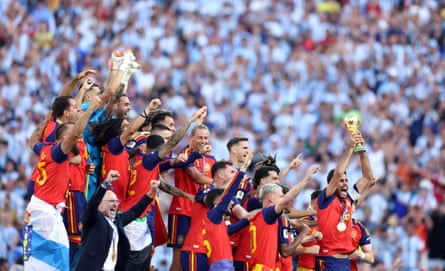
Fifa awarded non-competitive extensions to Fox and Telemundo in 2015 as compensation for moving the 2022 Qatar World Cup to winter, a perspective that was strengthened on the back of this year's record-breaking tournament. Fox's live coverage of Spain's extra-time victory over Argentina in the final was the most-watched soccer telecast in US history, with a peak audience of 51.685 million; five World Cup games brought in average audiences of more than 20 million; and the average viewing figure across all 104 matches was 7.7 million, twice the figure in Qatar four years earlier.
Telemundo's coverage, available through NBC's streaming platform Peacock, averaged a total audience of 6 million viewers per game, with Spain v Argentina and Mexico v England attracting peak audiences of more than 23 million, the highest-ever for Spanish-language broadcasts in the US.
The bumper audiences were extremely lucrative for the broadcasters, with figures from the advertising sales analysts Guideline showing that Fox and Telemundo generated a combined $1.19bn in advertising revenue alone during the tournament, almost three times the figure from Qatar four years earlier and more than their original rights investment.
Fox alone brought in $835m from World Cup advertising, with 30-second slots costing between $200,000 and $750,000 according to the Hollywood Reporter, and the six-minute hydration breaks generating between $2m and $9m per game.
Having left a considerable amount of money on the table because of the circumstances of the 2026 process, Fifa is determined to cash in this time around. Holding the auction only four months after the US hosted the World Cup appears a clear attempt to capitalise on the success of the previous tournament, which contributed the vast majority of Fifa's $4bn media revenues over the four-year cycle to 2026.
The addition of hydration breaks will give bidders such as Fox more revenue to play with, although Fifa will expect the option for extra adverts to drive up the price and take its own cut this time around, having missed out in the summer. The two three-minute breaks in each half were only finalised last year and did not feature in the 2026 tender documents.
"Sports advertising is much more valuable than entertainment programming as it has a broader reach," saysFrançois Godard, an independent media analyst. "And one-off events such as World Cups do not generally do particularly well for subscription services, who want year-round content.
"Fox in particular needs the World Cup and is heavily associated with it. They are the smallest of the legacy broadcasters and are reliant on sport, as well as news. Having said that, the market for sport amongst streamers is far more competitive in the US than in Europe. Netflix, Amazon and YouTube have all bought NFL rights, while Apple is investing heavily in Formula One, so I wouldn't rule any of them out."
Adam Kelly, president of the global sports marketing agency IMG, has a seat at the table at many rights negotiations and has long predicted the rise of the streamers, viewing the 2030 World Cup as the potential tipping point when a premium event could be exclusively bought in a major market by a streaming service for the first time. IMG has the rights to sell more than 70 global sports organisations, including the Premier League, World Rugby and Wimbledon.
In addition to the exclusive rights in the US for the 2027 and 2031 Women's World Cups, Netflix has secured exclusive 2030 World Cup rights in Spain. It must sublicense all of the Spanish national team's matches, both semi-finals and final and at least one match per day to a domestic free-to-air broadcaster to comply with government regulations.
"These entities are the future of broadcasting, as they are the best companies in the world at turning attention into earnings," Kelly says of the streamers. "Their model allows them to monetise better than their rivals due to their size, scale and the high consumption levels of their customers.
"Netflix in particular has built a sophisticated and lucrative advertising platform. They have the back-office capability and 2027 would provide a perfect test run. If they're successful in the tender for the World Cup it shows they are potentially the future of sports broadcasting."
"As a company, Netflix's unique offering is exclusivity, so why would they hand that to their rivals?" another broadcast source said. "There are no regulations in the US preventing exclusivity so I would expect Netflix to bid for and retain every game if they win."
Given recent reports that Netflix is exploring tabling an offer for NBC Universal after withdrawing its $85bn bid for Warner Bros last year, a future partnership with a linear network cannot be ruled out if it is successful. Some sources have even suggested that the tender has been timed deliberately to attract a competitive bid from Netflix, as the streamer is short of sports content to promote during the 2027 Women's World Cup. Others argue that Fifa would have been better advised waiting to build further on the interest created by that tournament.
The NFL's decision to pause its media rights process as it seeks an early renegotiation of contracts that are due to run to 2034 is likely to have played a part in the timing, creating a window of opportunity for Fifa to go to market. While a second round of bidding is possible after Thursday's opening round, the outcome is expected to be known within the next few weeks and could present a bounce for Gianni Infantino as he continues his presidential re-election campaign.