"What Argentina is doing in this World Cup is of a sacred order," Brazilian writer Milly Lacombe posted at the height of the tide of anti-Argentinian sentiment during this year's tournament. She was exploring the contradiction she felt around her support of Lionel Messi: "a player who is a God and a man who shakes Trump's hand".
Lacombe highlighted the importance of acknowledging the complexities around Messi and the Argentinian team. How is it possible that Messi was not speaking out against the racist incidents we all saw around the Argentina team, she asked. "That's why it hurts so much to see someone with Messi's power choosing to make himself small," she wrote.
Much was made of Messi's silence at the time. Then again, much has been made of his visible discomfort with words throughout his epic career. Journalist John Carlin once said that having interviewed Messi twice, he would decline a third opportunity, such was the challenge of getting the little giant to say anything of consequence. In 2010, Juan Sebastián Verón said he had never seen Messi as nervous as when he had to address his teammates for the first time as Argentina captain. In terms of public speaking, perhaps Messi's most famous outburst was at the 2022 World Cup when he told a Dutch player to "go away".
Despite this reticence, Messi has always meant something, even when he doesn't speak. Messi and Argentina were treated as darlings when they won the World Cup in 2022. By the time the 2026 final ended in defeat to Spain, they had become villains.
"That's why it's important to understand that when Messi, in the middle of a game that was lost, looks at the sky, and then after that he turns the game around and smashed it, there is something very mysterious there. Right? That we can't explain. That we just feel," Lacombe said after Argentina's semi-final victory over England this summer. "I started supporting England but by the end of the match I was weeping, surrendered to the commitment, the passion, the love that I saw the Argentina team pour on to the pitch. It's only in that moment of intense passion that we reach the sacred."
Not everyone surrendered to the sacred in the same way. The final against Spain lacked sublime power and opened the floodgates of vitriol from all corners of the globe. Argentinian fans were offended, hurt, defensive and aware they may have just seen Messi's last appearance in an Argentina shirt. When he confirmed he would end his international career – his final appearance for Argentina came against Benin on Tuesday – a wave of grief and gratitude swept the nation.
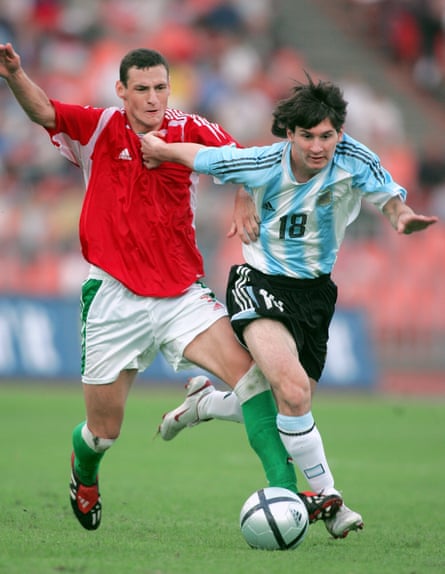
Messi grew up in Barcelona's youth system, and he was eligible to play for both Spain and Argentina. His debut for Argentina – in a youth match against Paraguay – set up a rush to ensure he pledged his allegiance to the country of his birth, before Spain could tempt him. He was already one of the Barcelona's academy most promising stars, but he was little known in Argentina. His father, Jorge, wanted nothing more than for his son to represent Argentina, and sent videos to then-manager Marcelo Bielsa hoping to expedite the process. For years, Jorge endured an uphill struggle to consolidate the ties between Lionel and Argentina. Messi's prowess, seemingly unstoppable in a well-oiled Barcelona system, did not come through at national level. For a long time, Jorge would ask his compatriots the same question. How can we get Argentina to love my son?
Now, as we start to write Messi's football obituary, some of the most grievous incidents against him are resurfacing. There was the time when a panel of pundits stood in a minute's silence in protest against Messi's performances for his country. He was criticised for not singing the national anthem. We learned that before Argentina matches he suffered bouts of vomiting and diarrhoea. Diego Maradona mocked him, saying he was no leader (although he would later make Messi Argentina's captain). And when the campaign to win over the nation stepped up and he gave interviews, his discourse was shockingly basic and he gave little away.
But Messi never gave up. He missed penalties, wept, and stood to take them again. "What characterized Messi in the national team is that he lost. He lost a lot. He's constituted in defeat" Argentinian journalist Alejandro Wall says.
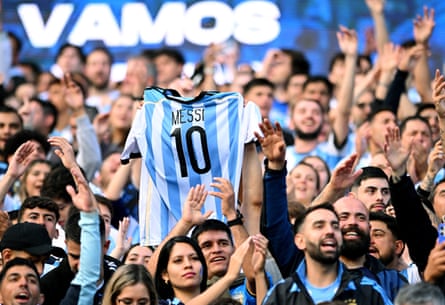
But the vitriol more often came from the press than the people. When he quit the national team in 2016, a spontaneous show of love and desire swept the nation, and he reversed his decision. From then on, the Argentinian Football Association's main priority mirrored that of Jorge Messi: finding a coach who could adapt the entire system to Lionel. It wasn't easy.
Perhaps it was only after Maradona's death in 2020 that the new Messi started to emerge. He walked taller, more confident and comfortable in his role as leader. In 2021, Argentina won the Copa América, and snippets of Messi's pep talks to his teammates filtered out. He made simple statements in his unmistakable Rosario accent, aspiring the 's' and not pronouncing most final consonants. His – and Argentina's – achievements since then speak for themselves.
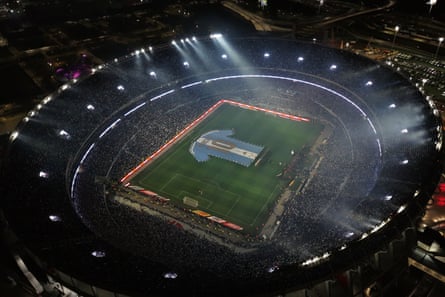
Tuesday's farewell at the Monumental Stadium – much like that first youth game against Paraguay – had a rushed, improvised air. The Argentinian FA struggled to secure opponents, not wanting to share box office with another footballing power. Benin were mocked by some as unworthy, and even Lionel Scaloni made reference to a desire to face bigger opponents than Bolivia and Burkina Faso, the other teams Argentina played this window. Burkina Faso ended up sending an Under-23 side who arrived a few hours before the match, and the stadium was not filled to capacity. Ticket prices were extortionate, and diehard fans refused to fall for what they called "a scam".
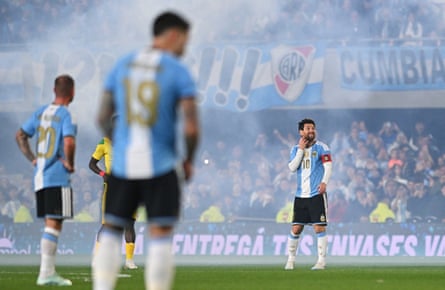
But against Benin they turned up in numbers. Earlier, Messi had picked up an honorary doctorate from the University of Buenos Aires, in a small and shabby ceremony in a back office of the Argentinian FA. Delicately produced homages to No 10 were aired. Social media posts full of hyperbolic emotion appeared. "Like Scheherazade, he mocked destiny match by match, to gift the Argentina people another day of his magic. The thousand and one nights of Lionel Messi with the light blue and white come to their end," read one post. "Whoah, hold it! It's 9am. I can't start weeping yet" came a swift reply.
To paraphrase Wayne Rooney, the entertainment around the match was crap. There was a drawn out homage by Soledad Pastorutti, who sang the same number she had once performed with Maradona. A veteran of the Falklands/Malvinas War sang the national anthem, and then clad himself in the same flag that fell on the pitch in Atlanta. The terraces chanted against AFA president Chiqui Tapia in a beautiful chorus, which went some way to atoning for the drone show at the end, with adverts for an insurance company glittering in the sky.
But football is about redemption, and the night was redeemed. Benin actually put up a fight, bookended by the team's captain gifting Messi a statue of a Dahomey Agojie, the group of women who fought against French occupation. Messi set up three of his team's three goals and took a penalty. He didn't miss.
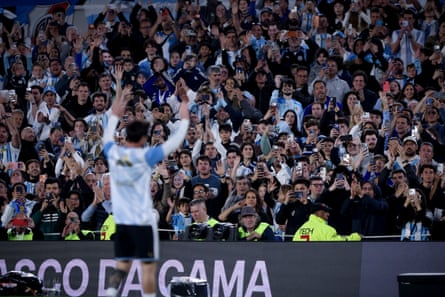
The cameras zoomed in on weeping faces but the sounds from the concrete terraces were decisively celebratory, relentless, trembling. It was football through and through. And Messi loved it. You could tell. He picked up the microphone and launched into a speech so articulate and confident that it merits a dissertation studying its every word. He addressed conspiracy theories surrounding the World Cup final: "Nothing odd happened. The match against England wore us out at an emotional level". He warned of hard times to come but said team unity is the way through.
"We had the dream of fulfilling our dream," he said, adding: "I don't know, I'm talking more than ever. I don't want to leave here. I love you". And Argentina loves him back.
As Lacombe said, when Messi looks at the sky, then turns a situation around and smashes it, there is mystery. There is something sacred.