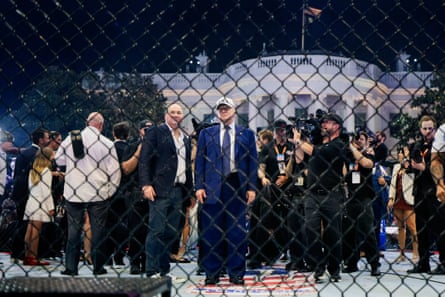
ver the weekend, President Trump floated his latest wild idea: that the man behind the Ultimate Fighting Championship and Power Slap, the ethically dubious "sport" where competitors take turns smacking each other with an open palm, could be his new White House press secretary.
Trump's post on Truth Social was about as subtle as a slap to the face. He Trump wanted the UFC chief executive, Dana White, whom he hailed as a "violent Fighter and Warrior", to take the job. And for six of his fighters to join him "to defend us against the Lunatic Left". But it also carried a certain logic. The UFC is Maga's sport of choice. Why couldn't it also be its praetorian guard?
By Sunday, Trump had backtracked. But the polarising reaction to the story, and the UFC's ever‑closer ties with Trump, illuminated a wider issue that researchers are starting to explore. Might our political views increasingly affect the sports we watch and play?
Of course, sport has always been political: No one is denying that. From Joe Louis's second fight against Max Schmeling in 1938, which became a battle by proxy between democracy and fascism, to apartheid South Africa, and the recent invasion of Ukraine, the two are inextricably linked.
But sport has long been regarded as a great unifier too, between left and right, young and old, rich and poor. Yet there is evidence that this era of hyper-partisanship may change that. In fact, as crazy as it might sound, someone's politics might even lead them to prefer Lionel Messi over Cristiano Ronaldo – or vice versa.
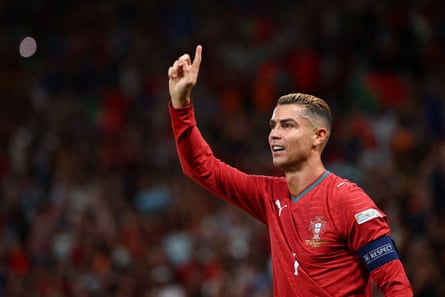
Yes, really. Recently academics in Singapore asked more than 10,000 people from 26 countries whether they preferred Messi or Ronaldo. They found that age, gender, education, social class and interest in politics did not significantly predict whether someone preferred one or the other. What did? According to the researchers, those "who were more liberal than the national mean were significantly more likely to prefer Messi".
Why might that be? Your guess is as good as mine. Maybe those on the right see Ronaldo as the epitome of hard work, while those on the left root for Messi because of his natural talent or slight frame? Either way, the research was conducted months before Ronaldo visited the White House last year, so that wasn't a factor.
There were other interesting findings. The most pro‑Ronaldo countries? Indonesia, Turkey, Mexico, Egypt and then Portugal, Singapore and China. Messi, meanwhile, was found to have the greatest support in South Korea and Argentina, followed by Finland, Spain and the UK.
Those in the survey were also asked how much they agreed that having a "strong leader who does not have to bother with parliament and elections" was a good or bad way to govern a country, to test for their views on authoritarianism. Curiously, those who had a higher approval for authoritarianism preferred Ronaldo.
There was one other notable finding. That respondents who consumed higher levels of short-form video news were also significantly more likely to prefer Ronaldo.
There is also intriguing evidence, at least in the US, that people on the right and left may have very different sports preferences because of their political views.
A few years ago the sociologist Joshua Woods used a combination of Google trends data, and the percentage of votes for Donald Trump in the 2020 election across the US, to examine the correlations between political ideology and the popularity of 53 sports. He found that traditional sports such as American football, baseball and basketball, along with rodeo and cheerleading, were more popular in areas that supported Trump in the 2020 election than in areas where Joe Biden received more votes. However figure skating, surfing and ultimate Frisbee, along with soccer and tennis, were significantly more popular in liberal areas.
One theory – as Woods notes in his paper titled Red sport, blue sport: political ideology and the popularity of sports in the US – is that conservatives are more likely to prioritise values such as tradition and conformity than liberals, and less willing to try new, alternative or low‑status sport.
The one surprise for Woods was how popular soccer, which is seen increasingly as an established sport, was in liberal areas. "To me, the most interesting finding in our study was the strong negative correlation between Trump vote shares and interest in soccer," Woods told me. "In other words, areas with greater interest in soccer were substantially less likely to vote for Trump."
It is hard to know how different things are in Europe given there are hardly any studies in this area. However one recent study based on 650 respondents in Belgium found no clear evidence that participation levels in different sports varied depending on where people were on the political spectrum.
"We know from the literature that right‑leaning individuals often choose well‑established brands, whereas left-leaning individuals are more likely to choose very niche or smaller brands," one of the authors, Jelle Muraille, told me. "So we thought it would be the same with sports. But it didn't seem that was the case."
Muraille is expanding his research, but it would be intriguing to see some studies that focused on Britain before too long. It is hard to imagine soccer in the UK not having broad support across all levels of the political spectrum, for instance, given it is so woven into the fabric of our sport. But I would not be quite as confident that some sports wouldn't skew a little right or left.
At the weekend I was talking to an acquaintance who works as a carpenter and doesn't use social media. Recently he was watching a boxing fight on YouTube when he was served an advert for the Reform party. This, to say the least, surprised him. "Is boxing a right-wing sport now?" he asked me.
Before, I would have dismissed that question out of hand. Now I am intrigued to find out whether it has a hint of truth.