No one better understands the precarious tightrope Abu Dhabi walks when it tries to balance its relationships with western Europe while weighing the complex geopolitics of the Gulf region than Manchester City's chair, Khaldoon al-Mubarak. He was eight when his father, ambassador Khalifa Ahmed Abdel Aziz al-Mubarak, left the family Paris apartment for work on 9 February 1984 and was assassinated on the street in cold blood by a Palestinian terrorist.
And no one outside the emirate's royal family could be more wrapped up in the project of making and maintaining Abu Dhabi as a significant and secure world power and the dominant member of the United Arab Emirates, a nation state still only 55 years old. His paternal grandfather, Ahmad Bin Abdul Aziz al-Mubarak, was chair of Abu Dhabi's Sharia judicial department and senior adviser to Sheikh Zayed bin Sultan al-Nahyan, the founding president of the UAE. As such, Ahmad Bin Abdul Aziz was the James Madison of the UAE (the founding father, not the Spurs player) in that he crafted the Islamic legal framework of the new nation in the 1970s.
Khaldoon's father was assassinated by a group led by Abu Nidal which, according to the CIA, was "the most dangerous and effective of all terrorist groups [and] the best organized of the radical Palestinian terrorist groups" before the emergence of Hamas. The murder was justified in a phone call saying that the UAE "had expelled Palestinian and Arab residents and was linked with American imperialism". In essence, they were accused of being too soft on the west, not radical enough for Palestinians.
Both al-Mubarak's grandfather and father have streets named after them in Abu Dhabi, with his father honoured as a martyr of the state. It is fair to say the City chair has honoured the family tradition as chief adviser to the UAE president and Abu Dhabi ruler, Sheikh Mohamed Bin Zayed al-Nahyan, for whom he first worked after graduating from Tufts University in Massachusetts. Given his father's martyrdom, the royal family is said to have looked out for al-Mubarak as a quasi-adopted son. According to a source in the Financial Times, al-Mubarak is "diplomatically in charge of the UK file as well as the China file … and he's the main liaison with the US administration" and has diplomatic immunity in the UK. That said, he appears to have made a rare misstep with his belligerent tone on Manchester City
According to Manchester City's lawyer Simon Cliff, it was al-Mubarak who dictated the aggressive confrontational stance City have taken with football authorities. As far back as 2014, when City were fighting their first Uefa charge, Cliff wrote, according to leaked documents first published by Der Spiegel: "Khaldoon says he would rather spend £30m on the 50 best lawyers in the world and sue them [Uefa] for the next ten years than agree a financial penalty."
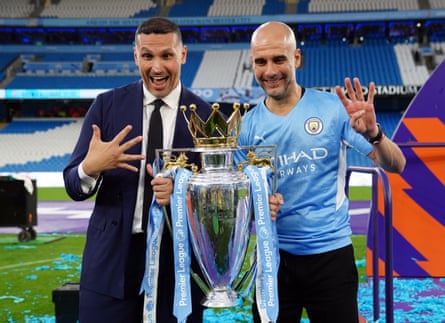
He backed down on that occasion, along with the co-accused Paris Saint-Germain, both clubs agreeing a small fine and minor transfer restrictions with Uefa. It is extraordinary that City kept fighting thereafter, whereas the Qatar-owned PSG accepted their punishment, cozied up to Uefa – with the club's president, Nasser al-Khelaifi, becoming chair of the European Club Association (now European Football Clubs) and chief opponent of the breakaway Super League – and built the most exciting and successful team in Europe, bringing admiration for the Qatari brand among observers willing to ignore human rights abuses. Al-Mubarak, in fighting to the end with City, appears to have broken an ambassador's cardinal law: don't embarrass your boss. Should City lose their appeal against an independent commission's finding that they were guilty of multiple breaches of financial rules, al-Mubarak may be instructed to organise the sale of the club.
"I'm sure that's the case with Man City," says Christopher Davidson, author of Abu Dhabi, Oil and Beyond. "More than that, I've been told by some [in Abu Dhabi] that it will be the case. I can't see any reason why they would stick around and try to rebuild the reputation after this. It's embarrassing the royal family now. I can't think of any example where things have gone wrong [for Abu Dhabi] and they've just kept plugging money into it. I think they'll play out the appeal – nothing to lose with that – but once that's done, it's all about how to get out before the owners are declared unfit, a far worse outcome. There are very clever people involved in Abu Dhabi who I'm led to believe will very strongly counsel this needs to be a quiet retreat because the longer they stay in the game, the more damaging it is and it will unravel any kind of soft power Abu Dhabi managed to gain."
In June al-Mubarak said "these sorts of jewels, you don't sell" and that there was "only intention to keep growing this". As for the wider threat to UK-Abu Dhabi relations, Davidson believes it is overstated. "Some of the reporting perhaps has portrayed Abu Dhabi as a bit monolithic. There are entire big and growing sections of Abu Dhabi state economy that are outside al-Mubarak's remit. Some of Abu Dhabi's biggest investments in the UK in recent years have been in renewable energy and the windfarms of Scotland from Masdar energy, which is chaired by Sultan al-Jaber, who's another key lieutenant of the ruler."
Davidson also cites the International Holding Company (IHC), which has huge biotech, shipping, healthcare and retail investments in the UK, including the Ivy restaurants, and is chaired by Sheikh Tahnoon bin Zayed al-Nahyan, deputy ruler of Abu Dhabi and brother of the UAE president and Sheikh Mansour. "It's inconceivable that these investments would be withdrawn," says Davidson.
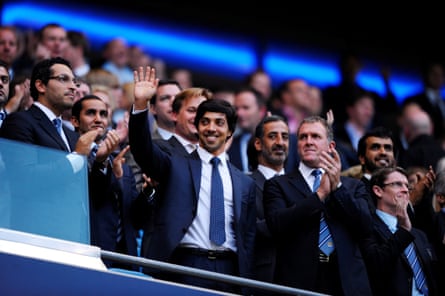
In May this year the UK signed a free trade agreement with Bahrain, Kuwait, Oman, Qatar, Saudi Arabia, and the UAE which it said could be worth £3.7bn a year to the UK economy. "The UAE was a major force behind getting that and it was a major accomplishment on both sides, so there's no prospect any of this is going to be interfered with," Davidson says.
Al-Mubarak will probably emerge from this fiasco largely untarnished, because City are a tiny part of his portfolio. "He can't possibly have known what's going on in every part of his empire," says Davidson. "My gut feeling would be that it's the layers below him. It's all about your legal counsel. I think the Qataris had very clever people working for them. This has been a case of poor advice being given to the senior Emiratis involved, a misreading of UK politics and a misreading of the Premier League and its bigger picture as a rules-based institution.
"I think the statements al-Mubarak has made, including the one early last summer that 'We will not sell' are the product of poor advice delivered to him and ultimately to Sheikh Mansour. It may be important to us in the UK but Man City has been a peripheral project [for Abu Dhabi]."