he 1912 Olympic marathon was held in a brutal Scandinavian heatwave, and before long Shizo Kanakuri of Japan was flagging. His journey to Stockholm had been debilitating; he had barely trained and struggled to sleep. At around the 16-mile mark he finally gave in. Exhausted and disoriented, he stumbled off the road and into a garden party, where – according to his bemused hosts – he sat and drank orange juice for an hour.
The next day, deeply ashamed at his failure to complete the race, he quietly took a boat back to Japan. In Sweden the mystery of the "disappearing runner" took on almost mythical proportions. Kanakuri's name was on the country's missing persons list for more than 50 years.
In the 1960s, a journalist tracked him down to Kumamoto in southern Japan, where he worked as a geography teacher. At great expense, Swedish television flew him back to Stockholm and ferried him to the spot where he had abandoned the race.
So it was that in March 1967, Kanakuri finally completed the 1912 Olympic marathon in a time of 54 years, eight months, six days, five hours, 32 minutes and 20.3 seconds. None of this, of course, was of the least sporting consequence. But it was a nice story, generating substantial interest, and the newspapers could fill their column inches, and the broadcasters could fill their schedules, and perhaps ultimately this was all that mattered.
All of which brings us, by a similarly circuitous route, to Tyson Fury v Anthony Joshua, a heavyweight fight that is often described as happening several years too late, long after the 38-year-old Fury and the 36-year-old Joshua have passed their fighting peak, years since either man has beaten anyone of world-class pedigree, a delay that makes Mayweather v Pacquiao look impromptu.
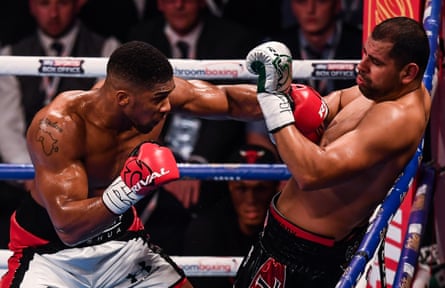
In fact Fury v Joshua is happening exactly as intended: at the sweet spot where commercial potential meets an absence of genuine jeopardy. Make this fight in 2021 and both men are putting titles, the undisputed crown, an entire fighting legacy, at terminal risk. Make it in 2031 and not even the combined bullshit wattage of Frank Warren, Eddie Hearn, Dana White and Turki al-Sheikh could persuade the public that this was anything other than a fairground sideshow.
No: it has to be now, before anyone stops caring. Like a market trader extracting maximum price for a fruit on the very brink of going rotten, this is the fight business operating on God-tier mode. "We will get it on at the right time," Joshua once said. That was in April 2016, when a fight with Fury would have been worth a fraction of the £150m it is worth now. When it comes to boxing, absence makes the purse grow fatter.
That this is often regarded as a minor annoyance, a glitch in the system rather than a fundamental existential-level malfunction, is just one of the reasons for boxing's slow drift towards mainstream irrelevance. Virtually every other sport on earth operates along the principle that at some point the best will meet the best, and assembles structures and rules and governing bodies that compel this into being.
Boxing is pretty much the only sport in the world where this is not true, which raises the germane question of whether it can really be considered a sport at all, at least in the modern, codified sense.
Naturally Fury has spent the past few weeks (Months? Years?) desperately trying to pin the blame on Joshua for not getting the fight made. In Fury's tale of the tape, he has been ready and waiting this whole time. With the exception of the two and a half years he spent out of the sport dealing with a combination of doping charges, substance abuse, and mental health crises.
Or the subsequent two and a half years he spent battling Deontay Wilder, not just in the ring but in the courts. As frequently thrilling as that trilogy of fights was, even at the time there was a sense we were missing out on something even greater; that as one rivalry was playing itself out, there were others suffering as a result.
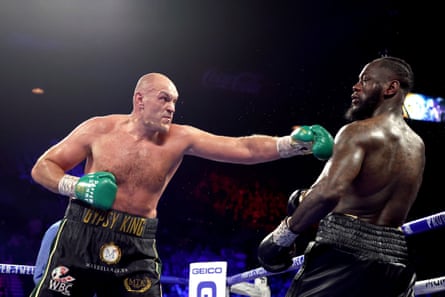
Then there were the retirements: around five in total, depending on how you count these things. It feels pleasingly nostalgic now to recall that Fury first quit boxing in 2013 ("1000000%, no matter what, ill never fight again"), then again in 2016, again in 2017 ("THE END"), again in 2022 ("the truth, the gospel truth, nothing but the truth, I'm done, no amount of material assets or money will make me come back"), and most recently from 2025 to 2026. I'm no expert in contract negotiation. But if you're trying to establish yourself as a bona fide sporting and business partner, maybe stop retiring every few years?
Cowardice will always be too strong a word for anyone who steps between those ropes and risks their health for our titillation. But it is a shame that a fight that could have defined an entire generation of British boxing is happening only when the stakes are so low. For all the biblical hype that will doubtless accumulate under the wheels over the next two months, what does this fight actually tell us? What gets settled or rewritten? Is it actually in anybody's interests for anything to be settled or rewritten, given the potential for an even more lucrative rematch sometime in late 2027?
Prizefighting owes its success to the ability to hold two ideas in its orbit at once. First, the sense of sporting ultimacy, the idea that what we are watching is a kind of pinnacle of raw human endurance, the very best fighting men and women on the planet. And second, the sense of vaudeville and pantomime, the deliberate and often provocative packaging of a product for entertainment and consumption.
Boxing has always been at its greatest when each has been in the service of the other. A Christmas cracker requires the colourful wrapping and the bit that bangs in the middle. Remove either and the whole concept falls apart.
But for years now, these ideas have been breaking in opposite directions. What we essentially have now is a sport increasingly rearranging around the two disparate poles of meritocratic sporting excellence and algorithmic celebrity power.
In the former, Moses Itauma is one of this country's best-kept sporting secrets, and an all-British world title clash between Daniel Dubois and Fabio Wardley is feted as one of the greatest fights of the decade but generates virtually zero wider recognition.
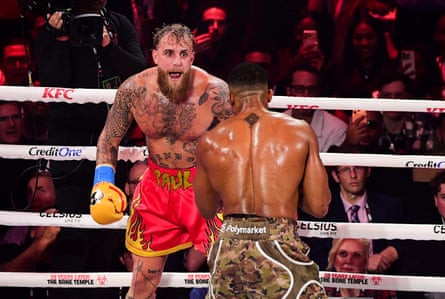
In the latter, the internet pest Jake Paul is one of the sport's most bankable names, the greatest heavyweight of his generation, Oleksandr Usyk, is fighting a kickboxer,Floyd Mayweather Jr is in talks about coming out of retirement to fight Mike Tyson, and Conor Benn and Chris Eubank Jr keep rematching for the next 10 years.
Which world does Fury v Joshua belong to? Which half of the marathon are we being invited to watch? I want to believe – and so do Netflix – that Fury can still be the force of old, rather than an increasingly monotonous provocateur. I want to believe in the Joshua of the 2010s, unscarred and optimistic, this beautiful man of beautiful clean lines. I want to believe this is sport. But deep down, I think we all know the answer.