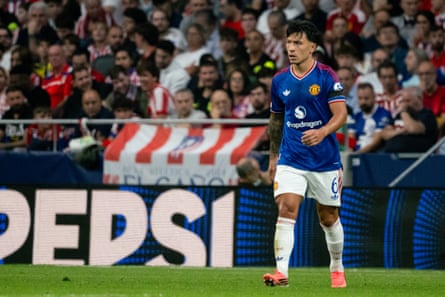
After Manchester United's 2-0 loss at Atlético Madrid, Lisandro Martínez teed off at the director of football, Jason Wilcox, and the rest of the executive. "We don't have the best squad at the moment compared with other top teams," said the defender. "I expect more [investment], 100%. I expect more from our technical director [Jason Wilcox] … Really poor [the Atlético defeat] – I have to control myself a lot but something is a reflection of the mirror of how our club is at the moment." Here we consider the key questions emerging from Martínez's explosive remarks.
Is Martínez's view reflective of the squad generally?
Yes is the short answer. The Guardian has been told the decision to target three midfielders in Andrey Santos, Youri Tielemans and Carlos Baleba caused bemusement in the squad that no other areas were strengthened in the summer. Carrick led United to third last term after the side only had 17 league games remaining when he took over in January, having been eliminated from the other competitions. The need for defensive reinforcements is particularly acute because the back four of Diogo Dalot, Martínez, Harry Maguire and Luke Shaw has been together since 2022. Martínez is out of contract next summer and it is thought the 28-year-old may not be offered a new deal or have his one-year option triggered by the club, so teammates are conscious his outburst also came because he expects to leave.
How culpable is Wilcox?
As United's director of football the 55-year-old wields near-unilateral power on football decisions, with only Sir Jim Ratcliffe, who controls sporting policy, above him. If the buck stops with the executive, the most recent transfer window was Wilcox's responsibility. This was the latest in a line of missteps on his United record. One concerns when Dan Ashworth (Wilcox's predecessor) was on gardening leave from Newcastle in the first half of 2024, Wilcox interviewed potential replacements for Erik ten Hag before, oddly, deeming that the head coach should stay. The Dutchman signed a fresh contract but was sacked that autumn. Another involves Wilcox's major falling out with the man he hired as the Dutchman's successor, Ruben Amorim, after which the Portuguese said the director of football had told him he should change his favoured 3-4-3 shape. "I came here to be the manager of Manchester United – not to be the coach of Manchester United," said Amorim, after a 1-1 draw at Leeds on 4 January (his job title was head coach). He was sacked the next day. Wilcox worked with Omar Berrada, United's chief executive, at Manchester City, where Berrada rose to become chief football operations officer, and Wilcox became academy director. Wilcox moved to Southampton and became director of football from summer 2023 until April 2024, when he joined United, having been identified by Berrada, so there is scrutiny of his experience at elite level.
How much blame is Carrick's?
The 45-year-old's ability to prosper is related to the quality of Wilcox's work, primarily in the market, so he cannot be solely responsible for a dire six points from six league games and two victories in all competitions all season. Yet by definition his role as head coach demands Carrick do the best with his resources, and that progress is made on the training ground. On matchdays there is scant excuse for United's disjointedness, inferior running stats and inability, twice, to take advantage against 10 men: the 1-0 loss to City and Saturday's 1-1 draw with Tottenham. How is Carrick viewed by his players? According to Santos they back him. "We believe in the manager, we believe in the whole staff, we believe in [ourselves as] players," he said after the Atlético game. "We are in a bad moment but we have to work to change this result.".
Is United's unity and discipline crumbling?
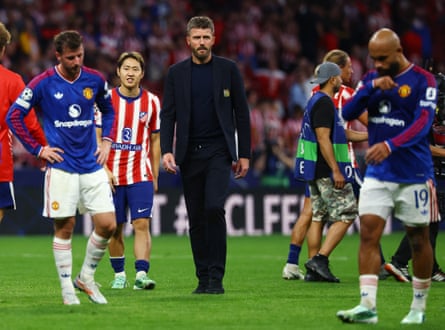
For further evidence see Amad Diallo's Snapchat post after the defeat by Atlético: "Fucking disgrace; I have no words." So United have a World Cup-winner, Martínez, aiming shots at Wilcox and by implication Ratcliffe and Berrada, and a fellow senior player, Diallo, cursing but in ambiguous fashion, adding to the sense of meltdown at the club because it is unclear whether the "disgrace" meant the performance, Martínez's diatribe, the squad his teammate referred to as not good enough, or something else. All of this is mirrored on the pitch, where United's 671.4km run in the Premier League is the fifth-lowest (Arsenal's 716.2 is the highest), and their 581 sprints the fourth-lowest (Brentford's 765 the most).
Where are the Glazers in all this?
In mitigation Wilcox can point to the six American siblings, who remain majority owners and whose family has placed an eye-watering £1.1bn-plus debt on the club that severely restricts the transfer budget. Wilcox oversaw a £155m summer outlay and a net spend of about £100m in a summer when City's corresponding figures were £457.5m and about £175m. City buying players such as Enzo Fernández (for a British record-equalling £125m), Elliot Anderson (£115m), Ayyoub Bouaddi (£81m) and Iliman Ndiaye (£65m) showed their greater financial muscle, helped by being much better sellers of talent. How they have reached this point has, though, been thrown into sharp focus by last month's verdict that they have serially cheated.
Are there positives for United?
Any straw should be clutched at so Carrick and his staff can view the first 97 minutes of Baleba's United career as a rosy augury. After entering on 59 minutes against Spurs, a cute swivel and deft chip to Bruno Fernandes was a moment as impressive as the rest of his debut, and at Atlético the 22-year-old hunted down opponents and crunched into tackles, suggesting his game contains energy, muscularity and skill. It's early days but perhaps if Baleba had been fit to start the campaign (he was recovering from an ankle problem) he might have affected one or more of the defeat at Hull, the 2-2 draw at Everton when Ainsley Maitland-Niles equalised late, the 1-0 loss to City when Phil Foden was sent off after 23 minutes or the Carabao Cup elimination by Brighton.