Towards the end of a positive day for Mirra Andreeva, one of the brightest young stars of women's tennis, the 19-year-old approached the broadcast cameras to dissect her excellent 6-4, 6-0 win against Elina Svitolina in her first match at this year's WTA Finals. Andreeva took her place alongside Madison Keys, the 2025 Australian Open champion and a guest reporter for Sky Sports at Indian Wells, who greeted her with a mischievous smile: "Hey, diva!" Keys said.
This was an obvious reference to the kerfuffle on the eve of the tournament when Jessica Pegula, known usually as one of the most congenial players on the tour, had been caught on a hot mic delivering a series of stinging criticisms about Andreeva in a private conversation with her coach. Pegula, who had just finished a practice set with an angsty Andreeva, described her rival as a "diva" who "needs to be humbled". Her comments spread instantly to all corners of the internet.
On the court, women's tennis is in the middle of one of its best eras in recent years. The depth at the top of the sport is so immense that every member of the current top 10 holds a grand slam title or WTA 1000 crown. Such is the strength of the tour, there was not even space in the WTA Finals – which pits the top eight players against one another – for the six-time grand slam title winner Iga Swiatek, who finished No 9 and missed the event for the first time since 2019.
Tennis players are some of the best athletes in the world, but beyond their on-court excellence one of the unique selling points of women's tennis has always been the honesty of its players. The WTA reflects the natural tension that arises between a large group of ruthless, single-minded competitors being charged with battling one another while sharing locker rooms around the world.
There are many examples of good sportsmanship, but this is also the sport of countless on-court disputes, drive-by handshakes and salty press conferences. Many women's tennis fans relish its tense rivalries and the drama they produce. In many ways, the spectacle provided by the WTA is perfect for the social media era.
The question, as ever, is how the WTA can repackage its countless strengths into a bustling, successful business and at a time when women's sports are exploding, and whether it can continue to maintain its status as the leading women's sport in the world.
The WTA had tried previously to take advantage of the significant financial windfalls that come with partnering with certain authoritarian governments, particularly China and Saudi Arabia, but these initiatives were failures for various reasons. One year into its tenure in Shenzhen, which had been agreed as a lucrative 10-year contract, the Covid-19 pandemic struck. The former WTA No 1 Peng Shuai then accused the former vice-premier Zhang Gaoli of sexual coercion. Peng's subsequent disappearance from public view led the WTA to insist boldly that it would not return to China until it could directly reach Peng.
The tour opted eventually to host events in China again, but Shenzhen walked away from the deal. This has had catastrophic financial consequences for the WTA, leading the organisation to sell 20% of WTA Ventures, its new business wing, to the private equity company CVC Capital Partners in perpetuity for $150m (£125m). The organisation is operating at a loss with low financial reserves.
A turbulent few years followed for the Finals tournament as it shifted from venue to venue without a permanent home and the WTA has had to draw on its own finances to help fund some of these events. Despite accusations of the WTA being used as a vehicle for sportswashing, its three-year deal with Saudi Arabia from 2024 onwards was supposed to provide greater stability, but the Saudi organisers did not intend to extend the event beyond its initial three-year deal. With conflicts raging in the region this year, the WTA opted to shift from Saudi Arabia a year early and find a new venue.
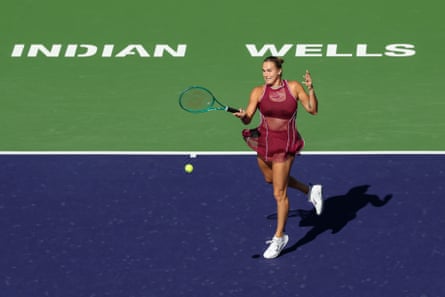
The WTA Finals will spend only one year in Indian Wells, a stopgap season, but it is still reflective of the new direction under the current chair, Valerie Camillo, who has been clear about the tour's vision in recent months. The WTA will seek to rebuild its flagship event in the US, with the WTA Finals moving to Charlotte, North Carolina next year. The US is evidently a more stable landscape with an established tennis fanbase as well as plenty of financial opportunity if the WTA gets things right. The WTA has also taken on operational control of the WTA Finals, rather than outsourcing its operations to the hosts.
Back in the familiar surrounds of Indian Wells, one of the most magnificent tennis venues on the tour in the California desert, things appear to have gone smoothly so far. Strong crowds have been present inside the 8,000-capacity Stadium 2. Much like on the ATP tour, so many players seem to be running on empty at the end of this gruelling season – including the world No 1 and defending champion, Elena Rybakina, who withdrew with a viral illness – so it remains to be seen just how much the tournament will catch fire. However, at the end of a great season that produced three excellent grand slam finals, this is at least a worthy spectacle.
The dramatic hot mic incident, meanwhile, has transformed quickly from a crisis into a shining example of how wildly fun women's tennis remains. Pegula quickly apologised to Andreeva and when the Russian later posted a picture of herself and Pegula from the pre-tournament photoshoot on Instagram, she included a winking caption of her own: "DIVAS".