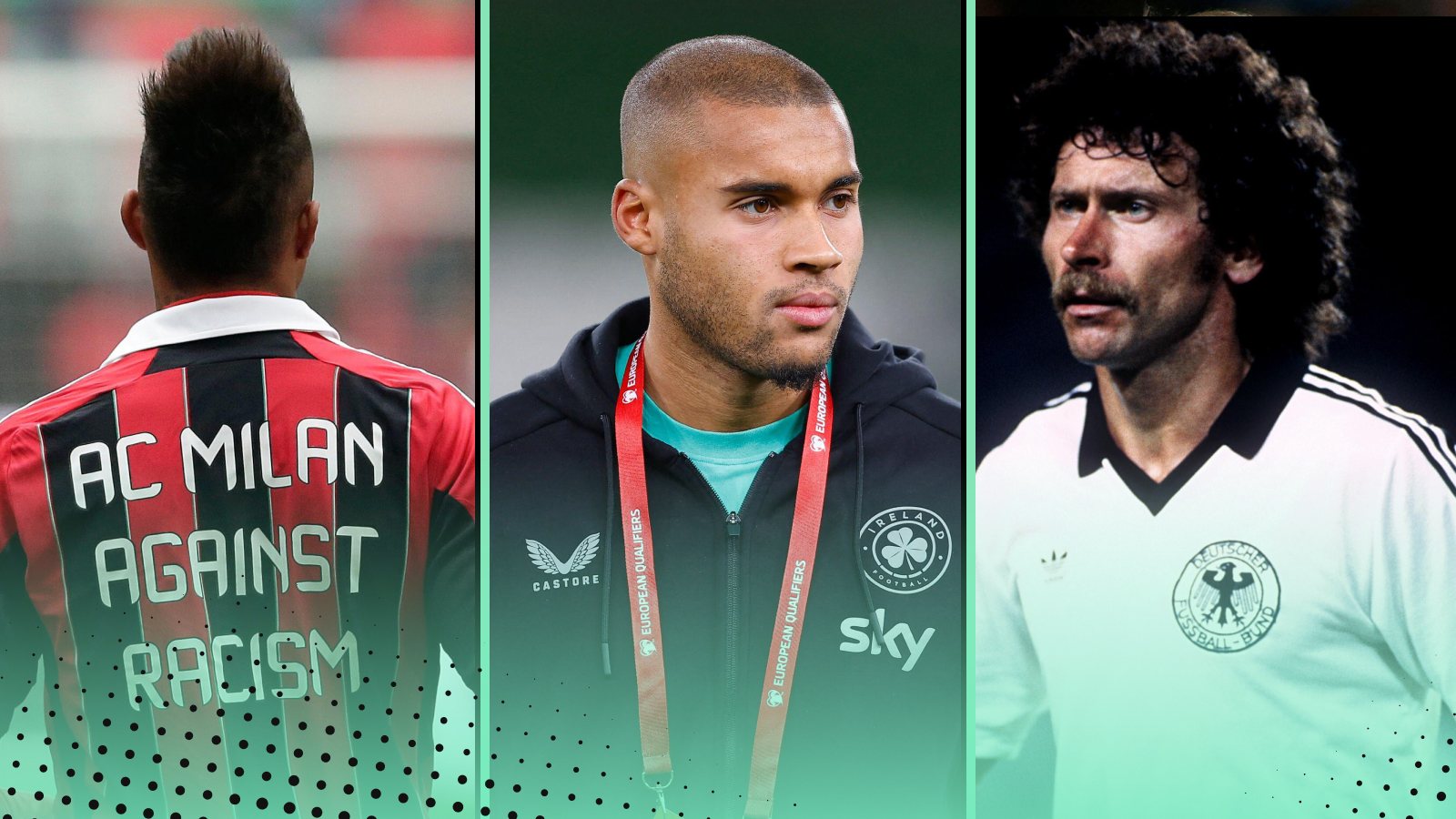
Gavin Bazunu will play no part in the Republic of Ireland’s match against Israel after withdrawing on ethical grounds.
He isn’t the first professional footballer to take a stand, but it doesn’t happen all too often.
We’ve compiled nine examples of footballers and football who stood up for what they believe in.
There’s been a lot of attention on the Republic of Ireland’s upcoming Nations League clash with Israel since the two sides were drawn against one another back in February. With Palestinian solidarity particularly prevalent in Ireland, there had been widespread calls for the team not to fulfil the fixture due to the situation in Gaza.
The game will be going ahead at a neutral venue in Serbia. Bolton Wanderers goalkeeper Bazunu will not be taking part, though.
“Representing my country means everything to me. I have the utmost respect for every single one of my team mates, the Manager, his staff and the Irish people,” he said in a statement.
“However I have reached a decision that I have not taken lightly. I am a man of strong faith and try my best to be a person of character and principle therefore I feel it would be wrong to participate in the upcoming fixtures against Israel.
“My decision is based purely upon my personal belief that the killing of innocent people is wrong. It is important to note that my stance is not in opposition of the Israeli people or the Jewish community but against the atrocities in the region.”
Johan Cruyff famously didn’t go to the 1978 World Cup, but the long-cited story that he boycotted the tournament on humanitarian grounds against the military junta that ruled Argentina.
That turned out to be apocryphal. Cruyff later revealed that he didn’t go to the tournament due to concern for his family, after a horrific kidnapping attempt they suffered months earlier.
West Germany legend Paul Breitner, who scored in the final when they won in 1974, did boycott Argentina ’78 on moral grounds, though. He was the only player to do so.
The Republic of Ireland international’s refusal to wear a poppy, having grown up in Derry (where British soldiers had shot unarmed civilians during Bloody Sunday), became a long-running thorny issue and a rallying call for some of the more jingoistic elements of the British press.
McClean also turned his back when an American stadium played out ‘God Save The Queen’ ahead of a pre-match friendly between West Brom and Charleston Battery in 2015.
There was a lot of talk about boycotts and protests ahead of the World Cup in Qatar, but in the end they amounted to little. We’re not including the Germany players covering their mouths before a group-stage match because, let’s be honest, they weren’t exactly leaving much on the line.
But former HJK Helsinki forward Riski refused to take part in a friendly against the 2022 hosts on ethical grounds.
“I got an invitation, then talked to the general manager and the head coach [Markku Kanerva],” Riski told .
“They understood, but were of a different opinion. I stuck with my decision, and have nothing more to add. I was pretty clear; I didn’t want to go.”
This puts most of these other examples into perspective. There’s standing up for your beliefs, and then there’s this.
Nasr-Azadani represented Persian Gulf Pro League club Tractor in his playing days. He’s currently serving a 26-year jail sentence in Iran following his participation in protests following the death of Mahsa Amini.
The worldwide union of footballers put out a statement while the defender was awaiting trial:
“FIFPRO is shocked and sickened by reports that professional footballer Amir Nasr-Azadani faces execution in Iran after campaigning for women’s rights and basic freedom in his country.”
“We stand in solidarity with Amir and call for the immediate removal of his punishment.”
Unfortunately, particularly in Serie A, it’s been all too common an occurrence that games get stopped due to racist abuse from the stands.
One noteworthy example was Kevin Prince-Boateng back in 2013. He walked off the pitch in protest at Pro Patria supporters’ racist chanting, having picked up the ball and kicked it at the source of the abuse just before.
“Shame that these things still happen… #StopRacismforever,” the Ghana international tweeted afterwards.
The Liverpool striker used his platform to make a political statement in Liverpool’s 1997 Cup Winners’ Cup clash with Norwegian outfit Brann. Beneath his shirt was a vest showing his support for the 500 sacked Liverpool dockers.
The dispute had begun after dock workers refused to cross a picket line, resulting in their dismissal. It would drag on for more than two years, becoming a major local cause.
Fowler was subsequently fined 2000 Swiss Francs for revealing the vest because UEFA regulations explicitly prohibit players from displaying any political logos at matches.
PSG & Istanbul Basaksehir players
A similar example to the one above, this one was particularly shocking.
It was alleged that fourth official Sebastian Coltescu used a racist term towards Istanbul Basaksehir coach Pierre Webo by the touchline.
The players from the Turkish Super Lig club carried off a walk-off in protest, and PSG backed them up by leaving the pitch too.
“It was something very new,” Football Against Racism in Europe executive director Piara Powar told BBC Sport.
“We had a group of players who walked off in solidarity with each other. Given the importance of the match, in the most watched club competition in the world, taking place in Paris, the significance can’t really be under-written.”
The Soviet Union were one of the strongest teams of the 1960s and 1970s, even if they never won the World Cup. But they missed the 1974 tournament after refusing to play Chile in a qualifying play-off.
A year earlier, General Augusto Pinochet had seized power in a coup, with left-wing prisoners subsequently executed inside Santiago’s National Stadium. The USSR asked FIFA to move the match elsewhere, but when that request was rejected, they refused to travel.
Chile still took to the pitch in their opponents’ absence. The hosts passed the ball around before eventually rolling it into an empty net, prompting the referee to blow for full-time.
READ NEXT: Five times fans stood up to racism: Williams, Leeds, Rayo Vallecano & more
TRY A QUIZ: Can you name every host country in World Cup history?