Game over. Two ultimately straightforward victories from three group games would ordinarily be enough to secure qualification in the Rugby League World Cup, but the format means that, barring a rugby league miracle from Tonga on Sunday, England are heading home early.
That format – 10 teams in lopsided groups and England in a unique position of being effectively out after defeat on the opening weekend – has been a point of discussion since that defeat by the Tongans a fortnight ago. But at some stage, the attention has to turn internally and the tough, uncompromising questions have to be asked of English rugby league.
Those questions can wait for another 48 hours after England defeated Papua New Guinea to ensure qualification for the semi-finals remains mathematically possible. But on a day when they had to not only win, but erode away a 68-point margin on Samoa before hoping they slipped up against Tonga later this weekend, the game is now almost up. A 22-point winning margin here was simply not enough.
Tonga are capable of beating Samoa, without question. But given how their biggest-ever winning margin in that ferocious Pasifika rivalry is 32 points, it is safe to assume that head coach Brian McDermott and his side can start packing their suitcases now. England or Great Britain, for the first time in the history of the Rugby League World Cup, will not be in the last-four.
It had all begun so brightly in Wollongong, though. For the opening 20 minutes England were sensational, opening up a 22-0 lead at a rate which suggested they could rack up the points they needed; with 67 enough to ensure a Tongan win of any kind on Sunday in Sydney would be enough to sneak through to the semi-finals.
But England fell away from their gameplan in spectacular fashion. It would take them another 50 minutes to score a fifth try and by then Papua New Guinea had scored twice to take the points-difference permutations off the table. Late tries from Morgan Knowles and Mikey Lewis at least ensured it would be two wins from three, but England's journey should end here.
This should serve as a defining moment for English administrators who, for too long, have had their heads buried in the sand. Within the space of four hours in Wollongong, their men's and women's teams were effectively sent home on what should be looked back upon as a dark day for the game.
An obsession with club rugby league, a congested domestic calendar which means England do not even have mid-season camps, let alone Test matches, and a decision to increase the overseas quota in Super League last year are all contributory factors to this mess.
They have a monumental task ahead to reverse that decline; it should start with agreeing a partnership with the NRL to allow them to get a grip on the English game, but that would rely on those in charge agreeing to take a step back and letting the grown-ups of rugby league run things efficiently.
McDermott wants to continue through to the next World Cup in 2030, and he should be given the chance – but he needs help from those above him. "It feels like we've lost the game," he reflected post-match. "Something remarkable is going to have to happen now for us to go through. If all we'd needed to do was win, we'd have handled it better … but it looks like we're going out."
The required margin of victory looked entirely likely early on. Tries from Matty Ashton, AJ Brimson, Dom Young and Harry Smith all came from front-foot, attacking rugby that had the Kumuls scrambling. Leading 22-0 after the opening quarter, the points required felt within reach: but England spurned at least three more glorious chances as half-time approached.
They drifted from the rugby which had served them so well early on, allowing Papua New Guinea a foothold. Dudley Dotoi and Gairo Voro's tries within five minutes after the break suddenly then made it 24-12 and as England continued to labour with the ball, it was now suddenly about holding on to win, not winning big. Thankfully, they were at least able to do that.
But when their fate is officially sealed on Sunday, the inquest should really begin into how English rugby league has found itself in the position among international rugby league's new-age pecking order it is in. Talk about who should coach the team or who should play half-back are distractions. If those in charge do not wake up, England will continue to drift from the world's elite.
England women crash out to pile on misery
England 6-24 Samoa
Meanwhile, England's women have failed to reach the final stages of a Rugby League World Cup for the first time, as the increasing gulf between the northern and southern hemispheres was once again exposed in a 6-24 defeat to Samoa which ends their tournament prematurely.
Stuart Barrow's side were in a winner-takes-all showdown in Wollongong against the Samoans, who were looking to reach the semi-finals of the World Cup for the first time. Their star-studded side, packed with NRLW talent, ultimately got the job done to inflict more misery on English rugby league and underline how they are being left behind on the international stage.
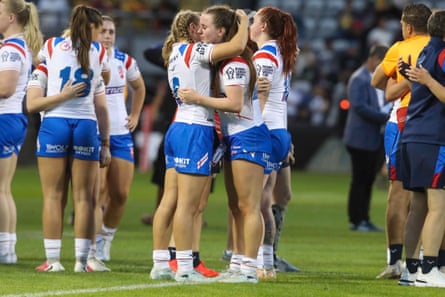
England's 78-0 defeat to Australia last week felt damaging enough, but failing to qualify from a group for the very first time is another damning indictment of where the English game now appears to sit in the pecking order. There will be a lengthy inquest back home for not just the men's side, but the women's too.
Credit must go to Samoa too, though. Their rise in the international game has mirrored that of the men's and while they too were beaten heavily by Australia in the opening weekend of the group stage, they are deservedly in the semi-finals for the very first time. They were much the stronger of the two sides in Wollongong and worthy winners.
It did not take long for Samoa's superiority to shine. The outstanding Freedom Crichton Ropati crossed twice in the right corner in the early exchanges, before the Parramatta Eels winger completed her hat-trick on the stroke of half-time. In contrast, England had showed little promise when they were in possession and looked comfortably second best.
They had to score first after the break, but instead went further behind when Mercedez Taulelei-Siala crossed to make it 16-0, with only missed goal kicks from the Samoans keeping it somewhat respectable. Evie Cousins would take advantage of a marvellous Hollie-Mae Dodd break to get England on the board, but it was already looking like nothing more than consolation.
That proved the case when Fanua Rimoni's late try put the seal on a wonderful win for Samoa, and ensured England would be heading home early. The sobering reality for the women's game in England is that there does not appear to be a quick fix to close the gap, however.
The NRLW is making huge strides year on year, with players now fully professional and the talent pool growing at an exponential rate. There is progress in England, but much slower – with only a handful of competitive teams, and none yet professional.
Barrow opted to take a young squad to Australia, with 11 of the group that travelled 23 or under. That is perhaps with the 2030 tournament in mind, but with the disparity in investment between the two hemispheres only widening in women's rugby league, England will head home early knowing there is a difficult few years ahead: and the prospect of the gulf only getting wider.