There’s an impossibly tempting, if largely meaningless trend, among Tottenham supporters watching their current team to wistfully wonder just what it would look like ‘If you just stuck Harry Kane in there…’
It’s entirely understandable. It’s still very early stages, but the signs that De Zerbiball is working are pretty clear across October’s three-game winning run, the clues for which were visible even when the results were still quite cack.
This is a Spurs team that, from the ruins and wreckage left by Thomas ‘We Will Lose Games’ Frank, does appear to have a lot of bases covered.
Above all, for the first time since the halcyon days of Dembele-Wanyama, they appear to have a fully functioning midfield combination.
But they don’t have a striker. Not a convincing one anyway. So of course the temptation to simply reinsert the best striker in the world, one who may have just pocketed a Ballon d’Or but whose finest individual achievement undoubtedly remains somehow scoring 30 Premier League goals in the depths of the Conte/Stellini anti-football season, is overwhelming.
And the answer is that yes, if you put Harry Kane and his inevitable 30+ goals in this current Spurs team you would elevate them to instant challengers.
Problem is, that while the specifics and history of Spurs make them particularly tempting for this thought experiment, it’s also true of pretty much everyone else who doesn’t have a Norwegian Goalbot 3000 to call upon.
More interesting, surely, to ponder just how mediocre a striker from Spurs’ past you could insert into the current team and still make a consequential change to the team’s fortunes, still elevate them toward greatness.
And the fantastic news here is that while Spurs have a history littered with really excellent forwards and strikers, there have also been a lot who were not that. Not in the record books anyway.
Just in the Premier League era, this is the club not only of Kane and Son, but of Teddy Sheringham and Jurgen Klinsmann, Jermain Defoe and Robbie Keane.
The two glorious seasons of Dimitar Berbatov’s silken insouciant magnificence. Fredi Kanoute’s ability to control any aimless long ball with his neck somehow. The unlikely bond between Peter Crouch and Rafa van der Vaart.
Go back to the days just before the Premier League and you’ve got Gary Lineker, a man who before Kane came along would have had solid claims at being England’s greatest ever pure goalscorer.
But Spurs are also the club of Helder Postiga. Of Grzegorz Rasiak. Serhiy Rebrov and Vincent Janssen. Of Roberto Soldado trying so very, very hard without any tangible success. And more recently of Richarlison and Dominic Solanke and the unforgettable Carlos Vinicius.
But there’s a middle ground too. And that’s where the interesting names are. A post-peak Les Ferdinand. The unfairly maligned Chris Armstrong and Darren Bent. And above them all perhaps the platonic ideal of a Tottenham striker. Steffen Iversen.
Nobody else sits so squarely at the very middle of any discussion of Spurs’ Premier League strikers. Neither conspicuous dud nor legend-securing success. A striker of incredible instincts and enormous talent, but whose six-and-a-half years at White Hart Lane produced only 36 league goals.
His Spurs credentials are impeccable. This is a man who scored a Premier League hat-trick in a 4-0 win at Sunderland three months after joining Spurs and then didn’t score another goal in his next 16 appearances spread across 18 injury-ravaged months.
Iversen feels relevant to the current mood at Spurs because he too occupies an interesting space in Spurs’ striker history. He arrived the year after Klinsmann left and his injury was a large factor in the German’s return to save Spurs from the drop in 1998.
He was there when Sheringham left for Manchester United, and there when he returned with all the medals four years later. Iversen was at Spurs long enough to wear Pony and Kappa either side of the adidas years.
Iversen’s Spurs career covers almost the exact same span as Ferdinand’s, yet in the mind’s eye it is almost impossible to picture them playing together.
Think of Iversen, and the striker partner who instantly comes to mind is not any of the greats or former greats whose time at Spurs overlaps his, but another nearly but not quite frontman in Armstrong.
The key thing, though, is that the bulk of Iversen’s time at Spurs sits between times of great wealth for the club up front. He arrives not long after Klinsmann’s first exit and shortly before Sheringham’s. His departure is fairly swiftly followed by the start of the Defoe and Keane years.
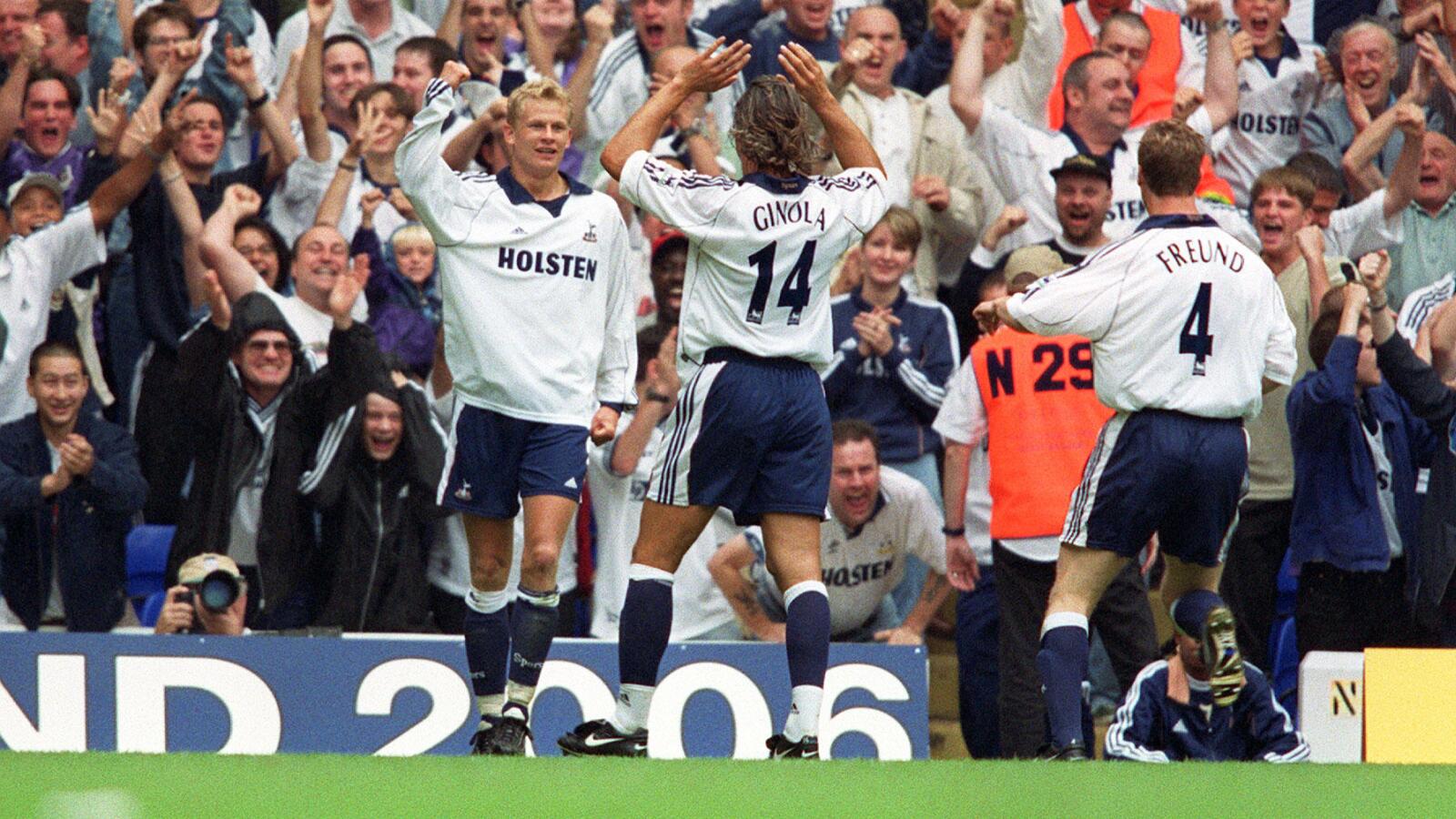
Spurs were not a good or successful side for most of Iversen’s time, but he nevertheless received elite service from such creative forces as David Ginola, Darren Anderton and Tim Sherwood.
But more important than any of that is the fact that he still might be my favourite Tottenham striker ever.
The obnoxiously performatively contrarian hill upon which I’ve crafted a lone stand before has been that Iversen possessed more natural talent than Harry Kane.
It’s a demonstrably absurd try-hard position to adopt, but there’s still no doubt in my mind that watching Kane so thoroughly maximise his talent, so relentlessly and single-mindedly wring every single drip of ability out of his mind and body only confirms just how good Iversen could have been with even a hint of that same mentality.
Iversen could and did score every type of goal. He just couldn’t and didn’t do so often enough. He had a predator’s instinct for right-place, right-time tap-ins, but only about 17 per cent of the time. He was magnificent in the air, occasionally. His long-range striking was world-class, on two or three occasions in six years.
It is almost certainly a product of Iversen’s Spurs career coinciding with the time in my life when I was most frequently to be found at White Hart Lane.
But the same is true of your Ferdinands and Armstrongs, and they don’t stir me in the same way. I can barely recall any of their goals or moments from random games – and their goals were really no less frequent than Iversen’s.
Iversen was just a more memorable footballer, and thus a more frustrating one. Armstrong never quite managed to deliver his best football at Spurs. Ferdinand’s best years were behind him by the time he completed a long-inevitable career arc that was always leading him to the Lane.
Iversen did play his best football at Spurs. And Iversen’s best football was utterly beguiling, and all the more special for being sighted so infrequently. Any fool can enjoy Harry Kane, for goodness’ sake. Missed Kane doing something remarkable, have you? Don’t worry, another one will be along in a minute.
If you missed an Iversen moment of equal brilliance – and Iversen’s best moments are a match for anything that big fraud Kane can manage – and you might be waiting three weeks or half a season or 18 f*cking months for the next one.
My memories of Iversen are coloured specifically by two matches in the 1999-2000 season. It was your classic early Premier League Spurs season. Long before they would bother the top six. Spurs were a sarcastically mid-table team in those days, and this was a sarcastically Spurs mid-table team.
They finished 10th. They won 15 games, and they lost 15 games. The year before, they’d just won their first trophy for eight years. They didn’t know it at the time, but they were a year into a nine-year drought that would be followed by the more famous 17-year famine.
It was not considered particularly extraordinary that Spurs had waited eight years for a trophy, yet nor was it a source of banter-skewering shock that they’d collected one. They were mid-table, a big club in name and history only, and often easy to ignore.
But occasionally they were magnificent. As we say, Iversen is the most Spurs of strikers.
The two games we remember Iversen for most contain five of his career-high 14 goals that season, but that’s not the point. Not all of the point anyway.
The second of the two games from that season that sit forever lodged as core memories was a 7-2 win over Southampton, in which Iversen scored a hat-trick.
#OnThisDay 11th March 2000. PL.
Tottenham Hotspur 7-2 Southampton.
Richards og (28) @DarrenAnderton (39) Armstrong (41,64) Iversen (45,78,90).
Tessem (26) El Khalej (33)
https://t.co/AYjh90qSVk
It was a game where Spurs trailed 1-0 and 2-1 before going in 4-2 up at half-time, the fourth goal and Iversen’s first nonchalantly driven home from 40-odd yards after a shanked goalkeeper clearance. Iversen was a man who could make the difficult look absurdly easy, and the easy look absurdly difficult.
You’d say he made that long-range effort look like a tap-in, except I remember what he used to make tap-ins look like on a regular basis, so it doesn’t really work.
On this day, though, Iversen was in the zone. He’d complete his second Premier League hat-trick – to this day there are still only two Norwegians with more – in the second half as Spurs ran riot.
On a personal note, this is a game that also says a lot about my own mentality – none of it good – because I vividly remember walking away from the ground on a day when a bang-average Spurs side had scored 7 (seven) goals and mainly being a little bit annoyed that the infamously goalless Steffen Freund had bungled what I correctly deduced would be his best chance to break that duck.
But it’s another game from that season for which Iversen truly holds a forever space in my footballing consciousness.
The game itself was a timeless if bog-standard bit of Premier League Spursery. It was against Leicester, as an improbable number of memorable and significant Spurs games seem to be. Spurs trailed 1-0 and led 2-1 before losing 3-2. So far, so Spurs.
Iversen scored both Spurs goals, but that’s not important either. No, what’s important is that he also did what remains in my mind the single most extraordinary piece of football I’ve seen from a Spurs player. I can picture it perfectly, well over 25 years on.
A fizzed hopeful clearance from the back has far too much pace and far too little direction to be of any use to a striker who finds himself running full tilt to intercept it while sandwiched between two large Leicester centre-backs who are probably Gerry Taggart and Ian Marshall, but that’s not important right now.
Iversen’s run doesn’t quite meet the path of the ball perfectly. It is going to whiz harmlessly behind him.
Except it doesn’t because, somehow, he has stuck his right leg out behind him, while running at full speed and not only made contact but spun the ball into the perfect spot in front of him so that he need not break stride to continue his run forward.
He does so, shrugging off the two large centre-backs who are probably Taggart and Marshall. Still running at full speed, he hammers a shot from 20 yards that seems certain to find the bottom corner to complete his hat-trick.
We wait for a net bulge that never comes. The ball doesn’t find the bottom corner, instead flying just the wrong side of the post and hammering into the advertising hoardings.
It would have been the best goal I’ve ever seen live. But the fact it was instead the best almost goal makes it all the more special.
It is not a famous moment, as the goal would have become. It feels personal, a moment of almost brilliance perfectly befitting a player of almost brilliance and shared only by the lucky few to see it almost happen in front of their eyes.
I’ve never watched a replay of it. I’m scared to. Even for writing this, I couldn’t bring myself to do it.
When the Premier League launched their vault of highlights covering every game ever played in the competition, I hovered over the link before swiftly shutting the laptop.
How could I watch it back? After all this time, there is simply no way the reality of it could match my perfectly imperfect memory of it.
What if watching it on the highlights he wasn’t so tightly sandwiched by two markers? What if the pass wasn’t as fizzed? His touch less secure or only a fraction as outrageous? What if the shot was actually much further away than I thought?
And perhaps most horrifying of all, what if it was in fact such a non-incident that it didn’t even make the highlights package at all? These were simply risks I was not willing to take with one of my favourite Spurs memories – of a missed chance in a stupid home defeat in the most instantly nondescript of mid-table Spurs seasons.
If that moment wasn’t precisely as good as I remembered – and how could it be – then I might have to consider the alarming possibility that I’d been wrong about Iversen in other ways too.
And that simply wouldn’t do. Because the thing with Steffen Iversen is that he had more natural talent than Harry Kane, you know.
READ NEXT: Ranking Daniel Levy’s 10 most expensive Tottenham signings from awful to brilliant
TRY A QUIZ: Can you name Tottenham’s top 30 goalscorers in the Premier League?