f all the many stories in Doping Top Secret: Children, a powerful new documentary from the German investigative team that helped expose massive Russian cheating in sport over a decade ago, one keeps replaying in my mind.
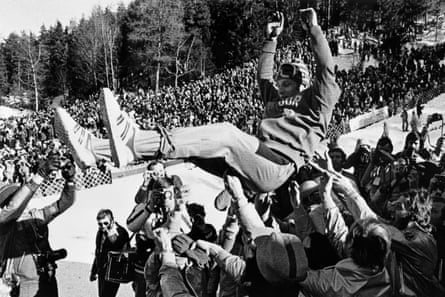
It involves an East German champion, who breaks his silence half a century on from his Olympic triumph to reveal how being pumped full of anabolic steroids at a young age accelerated his sexual development and, he believes, dramatically altered his behaviour and those of his teammates. "The system abused me as a young person for the good of the state," says Hans-Georg Aschenbach, who won ski-jump gold in Innsbruck in 1976. Although nothing can prepare you for what he says about how the drugs affected his libido, and particularly what he would sometimes do before he jumped off a large ramp.
"This feeling inside of you demands an orgasm," says Aschenbach, as he takes his mind back to his youth. "It grows. It builds. It drives you crazy. Even before a competition I had to go into the woods at some point and masturbate because otherwise that feeling would have pulled me away from my athletic performance. Only then could I think clearly again, a clarity that could culminate in my athletic peak." He then goes on to detail the effects such drugs had on his female teammates – and how coaches would exploit them. "It was a common practice where female athletes and young girls took these male hormones and developed an extreme libido, a sexual need, and a lot of people took advantage of that," he says. "Because in these times the girls, in particular, were ripe for the picking."
Those "people", the programme makes clear, included coaches – even though it was illegal for them to have relationships with minors. It is a story that illuminates a broader point. This documentary isn't just about child doping. It is about child abuse and criminality too. We would all like to hope those dark days are behind us. But the documentary makes a persuasive case – based on a six-year investigation across 25 sports and 50 countries – that there are plenty of modern-day equivalents.
When investigators visited the Dominican Republic, for instance, they found coaches and support staff willing to provide anabolic steroids and human growth hormone to children as young as eight to help them get into regional Major League Baseball academies on the island. The quid pro quo? If the young player ever makes it as a professional, those coaches know they will be entitled to a big cut of any deal. At one point an undercover reporter asks the coach who sells her the banned drugs: "And if the child asks if it is dangerous, what should you say?"
"No, it isn't," comes the reply. "If you don't want the child asking too many questions you just say they are vitamins."
As the programme makers note, that response is reminiscent of the methods of East Germany's state doping system. And, like back then, there are sometimes horrific consequences. One promising baseball player they speak to ends up developing kidney failure and needs a transplant. Another has a leg amputated.
There are similar stories in many other countries. In India, which is bidding to host the 2036 Olympics, investigators also find more coaches willing to dope children – along with athletics stadiums littered with opened packets of doping paraphernalia.
In the US, they speak to doctors willing to give human growth hormone [HGH] to 12-year-old tennis players who are slightly smaller than average. And the programme also raises concerns about China and its system, given its state control and past doping history.
We shouldn't necessarily assume the UK is immune either. When I spoke to Nick Butler, one of the documentary's reporters, he reminded me that during Covid an unnamed 16-year-old Premier League academy footballer was handed a nine-month ban for possessing HGH – although neither the player nor club was named, given his age.
So, how many under-18s may be doping? In January 2024, the World Anti-Doping Agency revealed that 1,416 minor athletes had tested positive between 2012 and 2023. That is not a big number. But when the programme makers used multiple prevalence surveys, which ask young athletes confidential questions about doping, they estimated that 10 million minors globally use banned performance-enhancing drugs. Yet if anything, that figure may be an underestimate because many of the surveys predate the sharp rise in social media, as well as the popularity of new drugs such as peptides.
So, what should the authorities do? Especially when anti-doping agencies already have limited resources, which they are quite rightly focusing on elite sport.
For a start, there needs to be a better recognition that the imbalance between coach and athlete-child is still ripe for exploitation and abuse. And when minors are convicted of doping, the entourages and suppliers need to be brought to justice. In 2021, for instance, the brilliant Russian skater Kamila Valieva was suspended for four years after testing positive for the banned heart medication when she was 15. Everyone knew she couldn't have sourced the drugs herself. Yet no one in her entourage has faced a punishment.
The documentary notes other such cases, including that of five female Egyptian national team weightlifters, the youngest of whom was 14, who were banned after testing positive for the same anabolic steroid. Yet no one else was sanctioned.
There is a broader point here too. The science suggests that those who dope benefit from a "memory effect" in the muscles – with the physical benefits from taking steroids potentially lingering for decades even after someone stops. It means that unless there is more testing of young athletes, there are dangerous incentives for young teens in power sports, such as rugby and the NFL, to take banned drugs before stopping when they make it and start being tested.
Better and more targeted education would also help. As would more resources for the authorities to go after coaches and suppliers. Given the billions sloshing around elite sport, it doesn't seem a lot to ask.