ésar Azpilicueta looks well. César Azpilicueta always looks well – "ah, Captain Handsome," one Chelsea fan says when told who's turning up – but today especially, smiling in the sunshine. Strolling in, he eases into an easier chair, golf course spreading out beyond the terrace, west of Madrid, and orders a detox almost as green. It is nearly 20 years since he played his first game and a few months since he played his last, training kit replaced by bermudas, loafers and a polo, a picture of relaxation. So what's it like being a footballer? "Well, different," he says. Then he laughs, which he does a lot.
It is not a laugh-your-head-off laugh, more a chuckle, a giggle, as if amused at everything he did. And for all the self-deprecation, the lack of triumphalism, he did everything. Now, at 37, it's not the same, although there remains much to do, Azpilicueta as understated and quietly busy as ever: "square," he calls himself. He's completed an MBA, a sports directorship diploma and there are media offers, a life to live. Matches to play still: against his kids the needle is never far away, he says. And although he hasn't found a seven-a-side team yet he will.
"I get up, take them to school, go to the gym. I do pilates some days. I walk the dogs, play golf, then it's after-school activities. I read, try to learn new things. I haven't yet thought: 'I'm bored,'" Azpilicueta says, although you wonder how long that will last. "Over the last 12 months I could see it. The summer before I already 'hit the post' with retirement. It's natural: a day comes … if only I could play for ever but it is what it is and you have to keep evolving. I'm enjoying it."
Don't get the wrong idea. "In terms of controlling your time, playing every three days, always waiting on the next message: 'Meet at …,' it's a release. But it's not a liberation because you're delighted to pull your boots on. An important part of your life ends; you kick a ball almost from the moment you walk, live your passion. Even last season – when there were days everything hurt, when you think: 'How can I get injured like that?' – I would make demands of myself, my teammates. I always liked that.
"I never thought I'd be a professional. I couldn't tell you the moment I thought: 'I'm a footballer,'" Azpilicueta continues, but he can tell you the score on his debut, for Osasuna in 2007. "One-nil win, Getafe." Celta de Vigo were the last opponents: a 1-0 loss in May for Sevilla. Between those, more than 800 matches, 508 for Chelsea. Only five players have played more for Chelsea; no foreigner has.
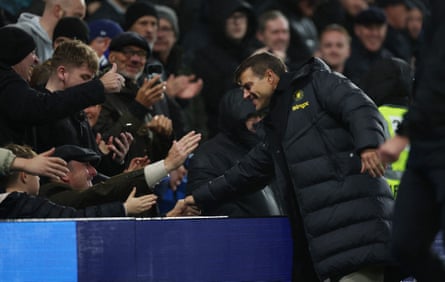
"I don't think anyone who saw me back then could explain how I played 11 years at Chelsea … and nor could I," Azpilicueta says, and there's that laugh again.
It's a long time since he stood before his new teammates and sang an Estopa track. He arrived in London with a labrador and a sausage dog; he left a legend and the captain, with three kids and every trophy, a European and world champion.
Asked to define his career in a word, Azpilicueta goes for: . Perseverance, consistency, commitment. He talks about the cruciate tear with Marseille aged 19 as a lesson, something that "changed my perspective and made me value discipline, preparation … Out of something negative I grew." About always adapting, always overcoming, becoming what managers need you to be. There's a laugh at the little lies of course I've played on the left, boss – and the hours spent alone practising, convincing coaches or teammates to stay behind with him and go over it again and again.
"I arrived at Chelsea late in the market [in 2012]," Azpilicueta says. "My representative said: 'We've spoken to Michael Emenalo, the sporting director, and they're signing younger players.' Oscar, Eden Hazard, Victor Moses, Marko Marin, Paulo Ferreira. I was 22. Doubts? … Olympique needed the money. Chelsea had just won the Champions League and I …"
That laugh. "I hadn't played for Spain. What did Emenalo see in me? It's hard to work it out. Also, what you are and what you become is different. You think: 'What's it going to be like?' Another country, another pace, but Juan Mata was there, Fernando Torres, Oriol [Romeu]. Doctor [Paco] Biosca, Ivan the physio. Petr Cech spoke Spanish. Hazard and I spoke French together. I could [communicate] with the Brazilians. But it wasn't just them. I integrated fast, tried to speak English.
"Not long after arriving there was this audience with fans. Fernando, Juan, Oriol and I. A Q&A. One said: 'Look, your name is very difficult. Can we just call you Dave?' Juan translated. I said: 'Yeah, sure,' thinking that they meant for the evening. And it stuck. Going down the street: 'Hey, Dave!' There was the occasional 'Dave' in the dressing room but mostly it was fans. I felt the affection.
"You go with an open mind and bit by bit carve yourself a place. Every time a new coach comes you think: 'Now what? Will I fit?' I started as a winger in Pamplona. At Chelsea I played right-back, left-back, a line of three which I hadn't played in my life … lots of systems, lots of coaches."
Twelve coaches, in fact. Azpilicueta played under all of them. ""You arrive at a historic club like Chelsea and just try to stay as long as you can. That machine makes demands of you every three days. What I really noticed was a hunger to win: either you have that culture or … forget it. At Chelsea a draw was a catastrophe. You see teammates come and go. The reality is the reality. On the pitch, you have to do it. It's hard? Yes. But you can't be sunk by a bad game. If you win: very good, done, next. If you can't perform, you're out … You have to manage that pressure.
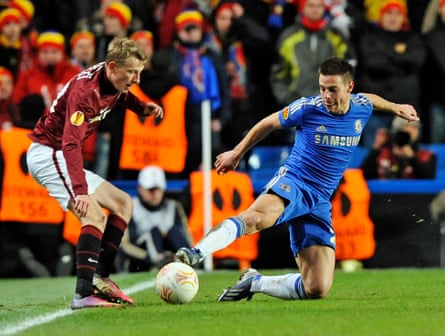
"I've had plenty of unpleasant days. I remember a 6-0 loss Manchester City." So then what? "For me, the first thing would be watch the video. Look at the data. But know that's not everything. Sleep, get up, turn it round. Get into to training first. And it's not just about you; some days it's about lifting up teammates too."
Preparation, he says, was fundamental. "I analysed everything. I want to know if when the winger receives, he turns left. I needed that. Football's not mathematical – 'this equals that' – but that information helps you have more control, feel readier. I don't know if I was more [serious] than others, but I was very , square. Others hardly did anything and were fine."
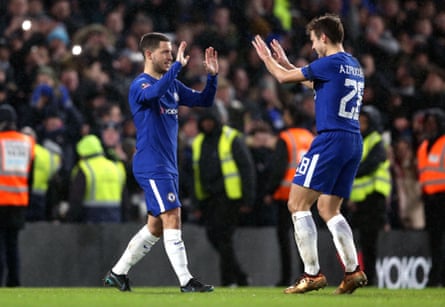
That sounds like Eden Hazard. Azpilicueta laughs. "He was more … more … relaxed. Not everyone has to be the same. I was very square, I prepared differently, I was like a robot."
Besides, Hazard was the best; it is his name, not Lionel Messi or Ronaldo's, that comes up when Azpilicueta is asked his toughest opponent. "I was fortunate to train with Eden. He didn't train 100%, but he forced you to. I had to kick him sometimes, haha! Playing together, he would say: 'Give me the ball.' I would say: 'Stay there, I'll defend for you.'"
Azpilicueta defended them all. "The first time I was captain was an FA Cup semi-final against Tottenham [in 2017]," he recalls. "We arrived late, no one said anything. [Gary] Cahill, the captain, was injured. We walk in and, the armband's in my place. Steve Holland says: 'Let's go to the referees meeting.' 'Oh, OK' … and that was it. I liked it. I don't think you change much; you have your own personality. You don't have to score two because you're captain. Besides, that was a one-off until later. But you do feel a little extra responsibility."
New players found Azpilicueta waiting for them, leadership through empathy and example. "Quite a few stayed at my house," he says. But if there is a portrait of his leadership perhaps it is him paying for the bus, covering petrol for the first team and youth team, when Chelsea's assets were frozen after Russia's full-scale invasion of Ukraine. And his reaction to that being put to him now. "Nah," he says. "Well. No. All of us. I didn't do anything anyone else didn't. We did it together, which is how things should be done.
"There a feeling of: 'We have this issue, going to sort this out,'" Azpilicueta adds, fist hitting the desk. "That situation was strange. We had won the Club World Cup, been with [Roman Abramovich] there and suddenly … it was the uncertainty: players, staff. Many people work for Chelsea, depend on that."
Underlying it all is the same basic principle, Azpilicueta says: "People. There are so many day-to-day who make it work. And sure, we're good at football but what really fulfils you is see people there with their families all together when you win, when you lift the Champions League."
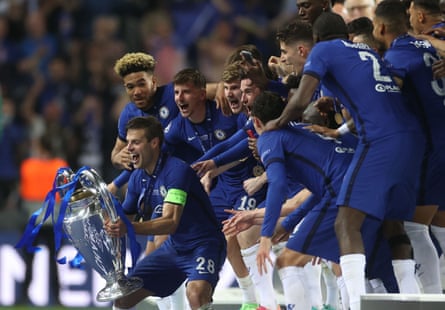
Have you got a photo of you lifting that cup? "At home? No. A friend gave me a very nice one framed but it's half hidden. I don't much like showing it off." If someone came to your house could they tell a footballer lives there? "No."
Twenty years on, a lifetime later, a footballer doesn't. So now what? "I don't know," Azpilicueta says, laughing. "Maybe I'll be here, playing off a better handicap. But I like football, being involved. I've done some co-commentating. I have the MBA, the diploma. Not because I necessarily want to be a sporting director tomorrow, but because it interests me, because it's nice to learn. I enjoyed the classes, meeting people, doing course work."
The practical experience is even better. "The last few contracts I negotiated myself. I've had various agents help over the years but a time came with Chelsea when I thought: 'What for?' I sit down with Marina [Granovskaia], then with Behdad [Eghbali] and Todd [Boehly]. As captain I had spoken to them about so many issues that when it came to my own I thought: 'I can do this alone.' I might have got a better deal, who knows, but I was comfortable that way. I was never looking for anything, I was happy, my family was happy, I felt loved and valued and that was it. I just wanted to go in to work every day."